
An animated loop for an LED screen has to pass three tests a social video never faces. It must be safe for people sensitive to flashing light, which in practice means three flashes or fewer in any second, the line drawn by WCAG 2.3.1 and by UK broadcast rules. It must repeat for an hour without anyone seeing where it restarts. And it must be built for the actual screen, its resolution and its LED map, not for a laptop. This is how Flavatars builds loops for concerts, stages and stands, and what to ask any studio before the show.
Why a stage loop is its own craft
A social video is watched once, on a small screen, from arm's length. A stage loop runs behind a performer for minutes or hours, on a surface many metres wide, in front of an audience that cannot look away. Everything that is harmless on a phone gets louder there: a flash fills a much larger part of the field of view, a restart point becomes visible after the third repeat, and a file made for 16:9 gets stretched across a screen that is nothing like 16:9.
So we treat every loop for a screen as a technical spec first and an image second. Three checks decide whether a loop is ready: flash safety, the seam and the fit to the screen.
“Everything that is harmless on a phone gets louder on a wall-sized screen.”
Test 1: three flashes or fewer in any second
Flashing light can trigger seizures in people with photosensitive epilepsy, and an event audience is large enough that some of them will be in the room. The accepted line comes from WCAG 2.3.1: content must not flash more than three times in any one-second period, unless the flashes are small or dim enough to stay below the general flash and red flash thresholds. UK broadcast guidance from Ofcom draws the same three-per-second line.
A flash here means a pair of opposite changes in brightness, light then dark or dark then light, large enough to cover a significant part of the view. On a wall-sized LED screen almost any full-frame change qualifies, which is why stage content needs this check more than web content does.
We measure it with a script, second by second, on every render. It catches problems the eye misses. In our own Motion Lab reel two neighbouring impact frames, each fine on its own, added up to more flashes per second than is safe, and that joint was rebuilt before release.
“Two impact frames, each fine on its own, can add up to an unsafe second.”
Test 2: a seam nobody sees
A loop that restarts visibly reminds the audience every few seconds that they are watching a file. The fix is designed in, not trimmed afterwards: the last frame's pose, light and camera position match the first, motion carries across the join, and nothing that should keep moving suddenly resets.
We check the seam by script as well, comparing the frames on both sides of the join. Where a loop has sound, for a stand or a social cut, the audio is edited to repeat to the sample, so there is no click either.
Test 3: built for the real screen
LED screens are rarely a single 16:9 rectangle. A stage can be a centre wall, two side columns and a strip above the band, all driven from one output through an LED map that places each part of the image on the right panel. Content made without that map either gets cropped or stretched.
Formats and resolutions are agreed with the venue's technical team before anything is animated, and files are delivered in the exact canvas and codec the playback system needs. At the Uzbekistan pavilion at the UN World Summit in Doha, for example, six of the films on its screens were made by Flavatars, each built in the native pixel map of its own LED panel.
Seven styles that work on a screen
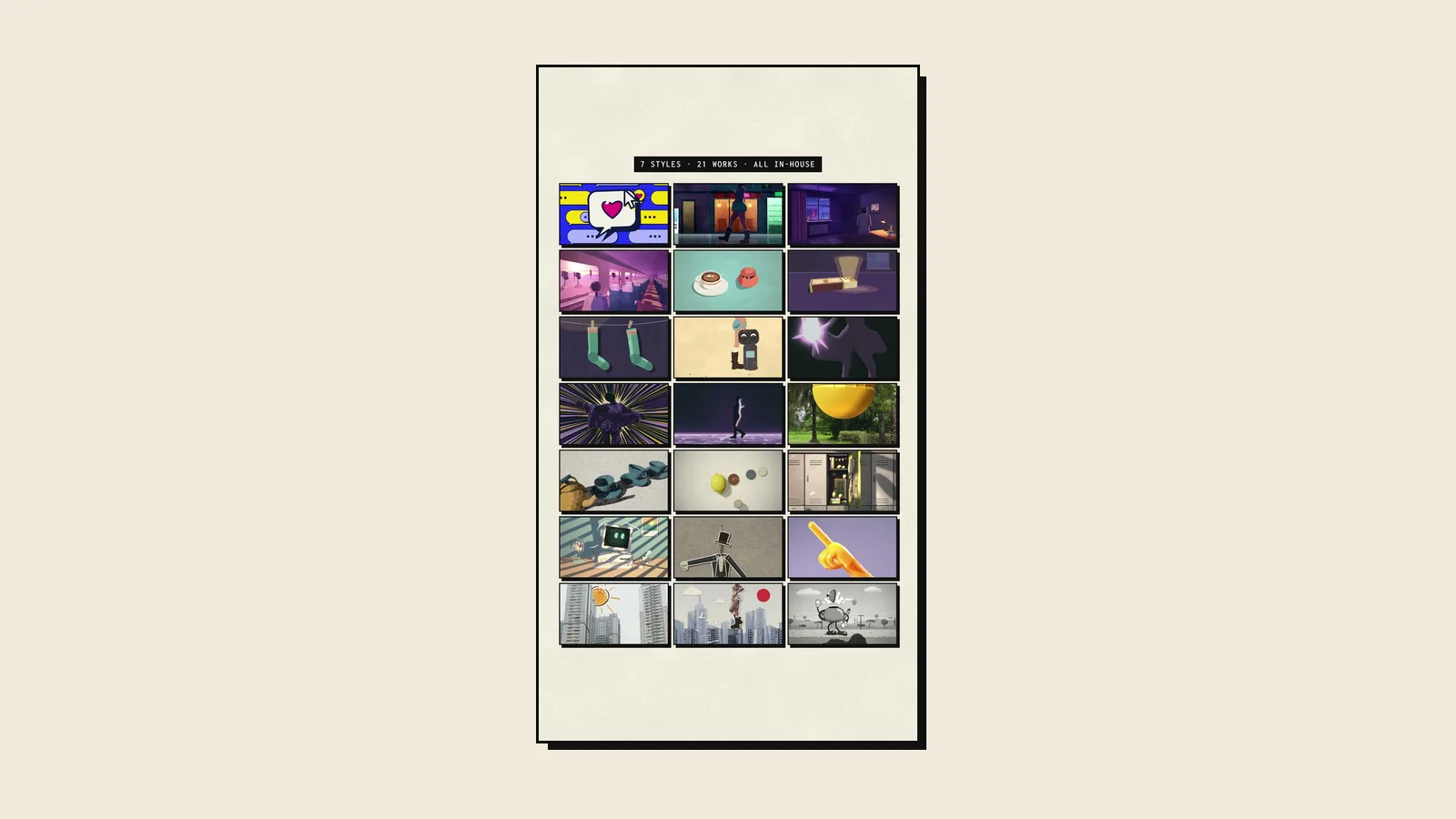
Loops do not have to be abstract VJ material. The Flavatars Motion Lab rebuilt seven animation styles as code, and each of them can run as a screen loop: lo-fi anime rooms and rainy streets, paper cartoons, anime FX with beams and speed lines, pop-art and Y2K stickers over footage, riso and stop-motion textures, 3D still life with a reveal, and collage or crayon drawn over real footage of a city or a crowd.
Because the timing follows hand-drawn rules, with one event per loop and holds that keep breathing, the loops stay watchable on the tenth repeat. Every frame is code or our own footage, with no image or video generators involved.
“Ask for the flash test result, not a promise.”
What to ask a studio before the show
Whoever makes your screen content, these questions separate a stage-ready loop from a pretty file:
- •
Do you test flash safety on the final render, second by second? Ask for the result, not a promise.
- •
Will you work from our LED map and the screen's native resolution?
- •
Which codec and container does our playback system need, and will you deliver exactly that?
- •
Can we see the loop repeat at least three times before sign-off?
- •
If the show has live music, is the loop timed to a tempo or free-running?
How we deliver loops for events
Our concert and event visuals service covers full-show packages, single tracks and stand loops: flash-safety checked, seam checked and built to the screen. If you have a show, a stand or a stage coming up, send the brief through the contact form with the screen layout, and we will tell you what fits the timeline.
Related: How to make animation feel alive · Flavatars Motion Lab: Seven Animation Styles, Rebuilt as Code