
Work · Event screens · WSSD2, Doha 2025
Uzbekistan at the UN World Summit
Eleven screens, 40+ heads of state and government, one pavilion in the Top 5 of the Summit. Six of the films on those screens — made by Flavatars.
- 40+
- heads of state and government at the Summit
- 14,000
- participants in Doha, 4–6 Nov 2025
- Top 5
- best exhibition stands — Uzbekistan’s pavilion
- 11
- screens in the pavilion — six films here are ours
In short
For Uzbekistan’s pavilion at the Second UN World Summit for Social Development — Doha, 4–6 November 2025 — Flavatars created the AI-made screen films. Concepts came from Gubsky Talent Hub, authors of the pavilion’s concept and identity; we brought them to life: stills in Nano Banana, animation in Google Veo 3.1, then the edit — each film composed to its LED panel’s native pixel map. The stand entered the Top 5 of a summit with 40+ heads of state and government.
The main film · 2:01
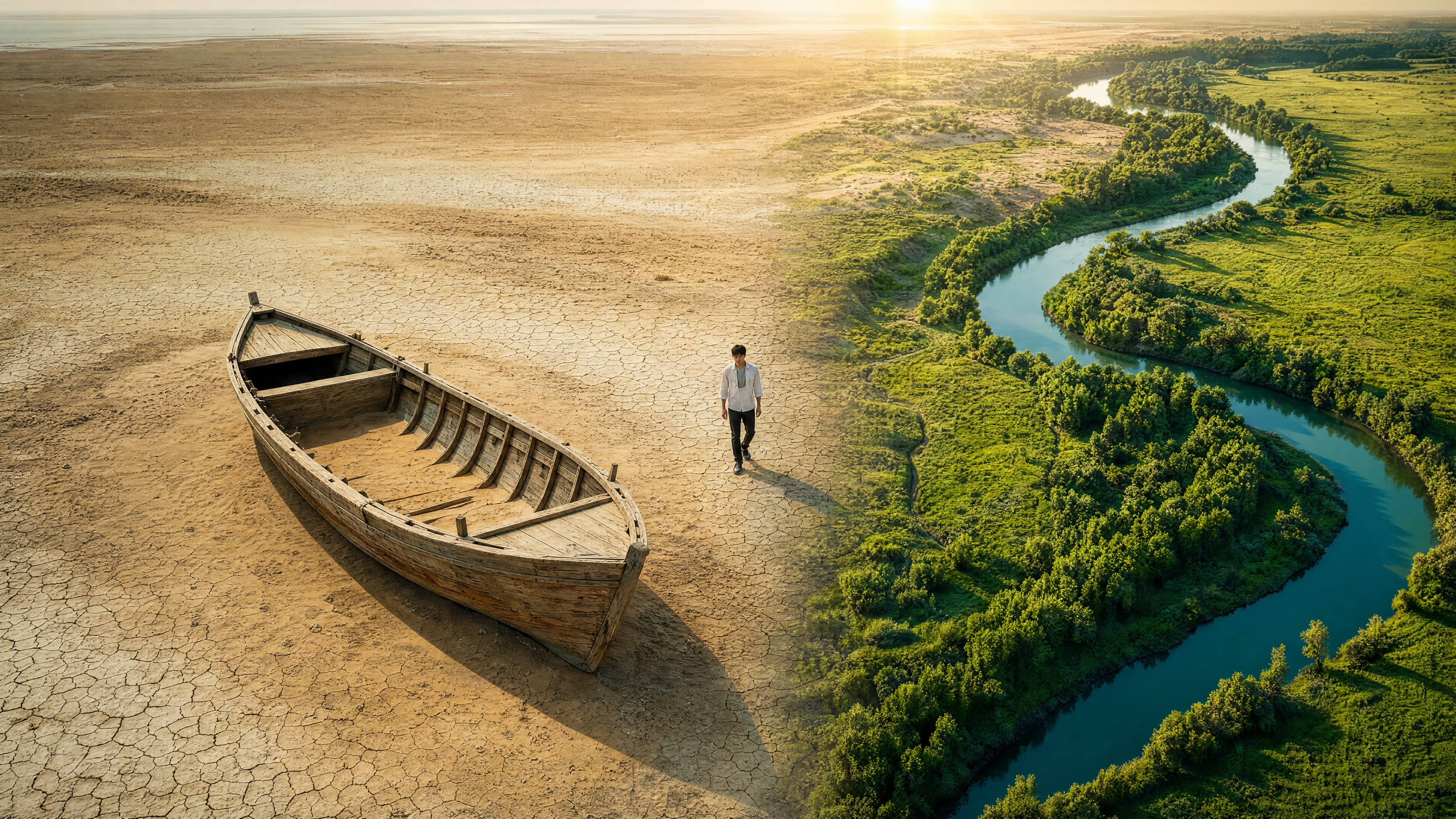
The sea that walked away
The soundtrack — ambient, music and an English voice — was added by Flavatars for the web version. At the Summit the film ran silent.
The emotional centre of the pavilion: the Aral Sea story. A dried seabed and a boat resting in salt. An elder’s face. A man walking the bottom of a vanished sea, holding seeds instead of nets. Then — a sprout in the sand, fields finding their colour again, a child running through tall grass, a river winding home through green.
«What a land can heal, a people can build.»
On the exhibition floor it played without a single word — light, faces and time doing all the work while presidents and delegations passed the screens.
The stage
A summit the whole world attended
The Second UN World Summit for Social Development gathered about 14,000 participants in Doha — more than 40 heads of state or government, 230+ ministers, the leadership of global organizations. Countries came to show what they are doing about poverty, work, and social justice.
Uzbekistan answered with a pavilion whose creative concept and identity came from Gubsky Talent Hub — a distinctive architectural stand whose walls were screens, each telling one reform as a human story. The pavilion was recognized among the Top 5 exhibition stands of the Summit.
The screens · shown silent
Films built to the architecture
No two panels in the pavilion shared a shape, so no two films do either — every piece plays here at its LED screen’s native proportions, exactly as the installation ran it: silent, looping, part of the wall.
Two childhoods
One boy, split in two: a childhood in the cotton field — and a childhood in school. The reform, told in a single frame.
«I am not afraid»
Children draw their homes and hold up the words. Protection of childhood as a promise, written in a child’s hand.
Rooms without barriers
Libraries, campuses, offices — people in wheelchairs studying and working in the same light as everyone else.
The INSON centres
Social-service centres in warm daylight: staff meeting the elderly at the door, staying beside them all the way.
Women who lead
Boardrooms, handshakes, a city at dusk — the widescreen strip about women in Uzbek business and public life.
How it was made
Stills → motion → architecture
- 01
Concepts from the show team
The creative concepts of the films came from the Gubsky Talent Hub team, who built the pavilion’s concept and identity. Oleg’s job was to bring them to life on screen — frame by frame.
- 02
Stills first
Every story began as a series of still images generated in Nano Banana: casting, light, wardrobe and composition locked before any motion existed.
- 03
Then motion
The approved stills were animated in Google Veo 3.1 — walks, water, wind and faces — and cut together into films that loop cleanly on an exhibition floor.
- 04
Built to the architecture
No two screens in the pavilion shared a shape. Each film was composed to its LED panel’s exact pixel map — 612×1302, 936×1338, a 1082×518 strip — content as part of the structure.
- 05
Silence by design
On the exhibition floor the screens ran without sound — the films had to speak in light and faces alone. They play the same way here; only the Aral film carries a soundtrack Flavatars added for the web version.
Credits
Pavilion — creative concept and visual identity
Gubsky Talent Hub — producer Elena Romanenko; creative team Synthesis / Iaroslav Gubskyi / Yevgeny Mosin
Film concepts
The Gubsky Talent Hub creative team
AI screen films — stills, animation, edit
Oleg Pylypenko (Flavatars)
Pipeline
Nano Banana · Google Veo 3.1 · edit
Also in the pavilion
Several screens ran real filmed footage by other authors — not shown on this page
Soundtrack of the Aral film on this page
Generated by Flavatars; the event showed the film silent
Eleven screens. Heads of state and government walking past. The films had three seconds to make them stop.
The facts
Everything, in one table
| Event | Second UN World Summit for Social Development (WSSD2) — Doha, Qatar, 4–6 November 2025 |
|---|---|
| Scale | About 14,000 participants; more than 40 heads of state or government; 230+ ministers |
| The pavilion | Uzbekistan’s exhibition stand — recognized among the Top 5 best exhibition stands of the Summit |
| Pavilion production | Creative concept and visual identity — Gubsky Talent Hub: producer Elena Romanenko; creative team Synthesis / Iaroslav Gubskyi / Yevgeny Mosin |
| Flavatars part | The AI-made screen films of the pavilion — created by Oleg Pylypenko from the show team’s concepts: stills, animation and edit |
| Pipeline | Nano Banana (stills) · Google Veo 3.1 (animation) · edit by Oleg Pylypenko |
| The screens | Eleven screens in the pavilion; each film composed to its LED panel’s native pixel map (612×1302, 530×968, 486×936, 936×1338, 1082×518, 384×708) |
| Shown silent | On the exhibition floor the films ran without sound — and they play silent on this page too |
| The main film | The Aral Sea story, 2:01 — a sea that walked away and a land that answers with green; in the web version it carries a soundtrack added by Flavatars |
| The stories | Two childhoods (cotton ↔ school) · «I am not afraid» · inclusion · the INSON centres · women in leadership · the Aral rebirth |
FAQ
Quick answers
What is WSSD2?
The Second United Nations World Summit for Social Development — a global summit on poverty, inequality, decent work and social justice, held in Doha, Qatar, on 4–6 November 2025. It gathered about 14,000 participants, including more than 40 heads of state or government.
What did Flavatars make for Uzbekistan’s pavilion?
The AI-made films that ran on the pavilion’s screens: six works shown on this page, from the split-screen story of two childhoods to the Aral Sea film. Oleg Pylypenko created them from the show team’s concepts — generating the stills, animating them and editing the films.
Who designed the pavilion itself?
Gubsky Talent Hub — the creative concept and visual identity of Uzbekistan’s exhibition: producer Elena Romanenko, creative team Synthesis / Iaroslav Gubskyi / Yevgeny Mosin. The pavilion was recognized among the Top 5 best exhibition stands of the Summit.
How were the films made?
In three steps: still images generated in Nano Banana locked the casting, light and composition; Google Veo 3.1 animated them; Oleg then edited the sequences into clean exhibition loops, each composed to its screen’s exact pixel dimensions.
Why do the films have unusual formats?
Because each one was built for a physical LED panel in the pavilion’s architecture — a 612×1302 column, a 1082×518 strip, a 936×1338 wall. The films on this page play at those native shapes, the way the installation showed them.
Why are the films silent?
They were silent at the event — exhibition screens speak in light and faces, not sound. This page keeps that. The one exception is the Aral Sea film, for which we generated a soundtrack — ambient, music and an English voice — so it can be watched here as a complete piece.
What is the main film about?
The Aral Sea: a sea that walked away, the people who stayed, and the land that slowly answers with green — seeds instead of nets, gardens, a river finding its way home. It ran on the pavilion floor as the emotional centre of the exhibition.
Can you make screen content for an exhibition or pavilion?
Yes. We build films to the architecture — native pixel maps for every panel, loops that hold attention on a crowded floor, and stories that work with or without sound.