
Nobody in the room spends the evening studying the avatar's face. They wait for the sentence that carries your product name, and that single word decides whether anything else on the screen gets believed. Upgrading the rendering model will not save it, because the failure happens in the audio. Voice casting and the phonetic preparation of the script settle the outcome, and both of those live in the writing stage of the project.
What actually goes wrong
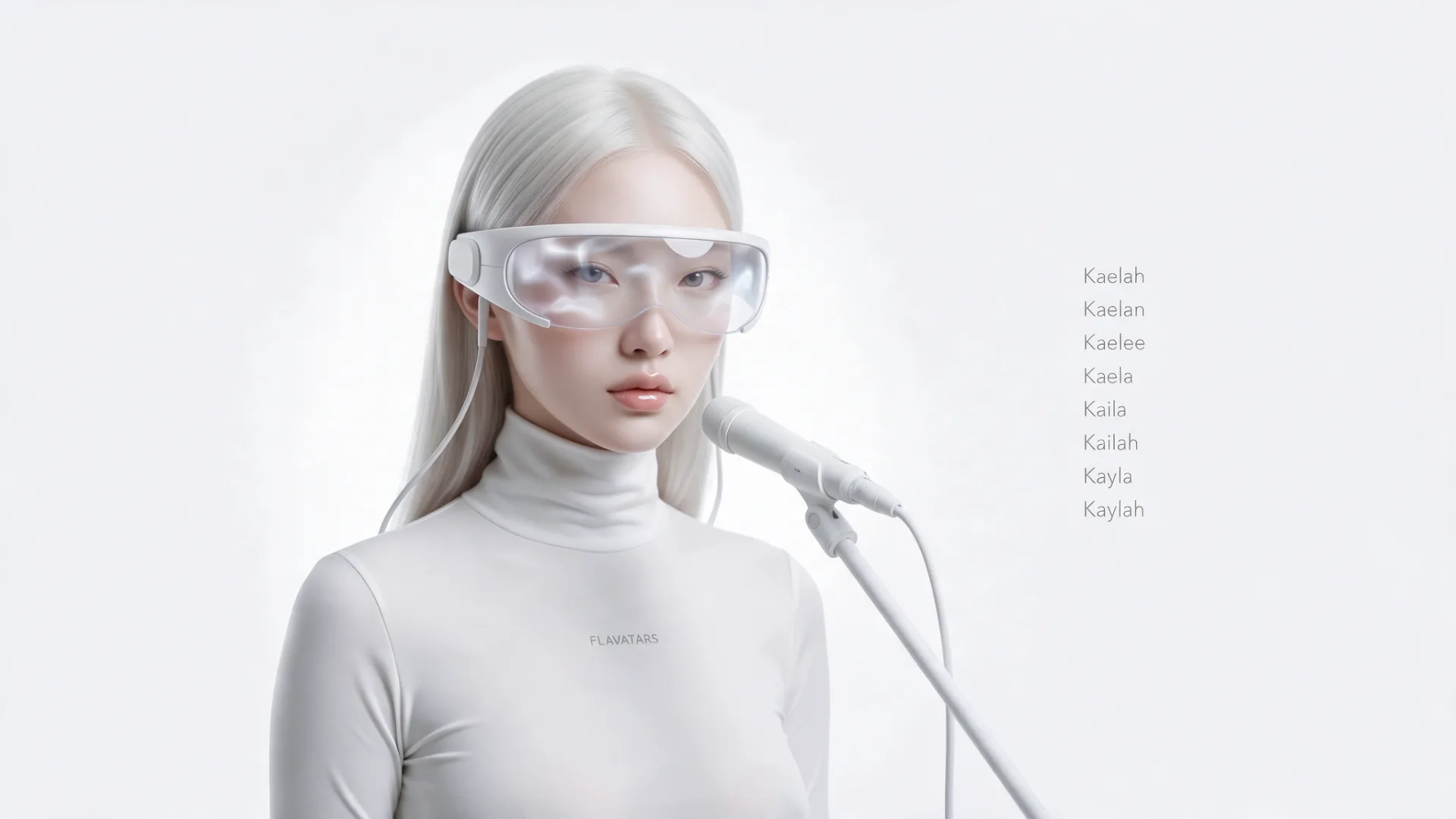
Corporate AI avatars fail on proper nouns. Product names, sub-brands, the surnames of colleagues, the city hosting the event: a speech synthesiser reads letters and hands you a plausible word with the stress in the wrong place. On a 2026 congress film we respelled one name eight different ways inside a single 15.5-second audio file before the voice said it correctly. All eight attempts are still sitting in the filename. The renderer had nothing to do with the fix.
One file, eight spellings
Flavatars built the AI layer for EVOLUTION, the annual distributor congress of Pernod Ricard Kazakhstan: design, production, synthetic voices and animation for the AI host and the digital twins. The event was produced by FIRST MEDIA and directed by Iaroslav Gubskyi, with Andrey Glushik and Yana Abraimova on the creative team. The host is called ALEX, described in the programme as a virtual assistant and analyst. He carries 16 spoken cues, 9 minutes 47 seconds of finished speech, the longest single cue running 1:43. Across the evening he turns up in seven of the programme blocks and stays off the screen through blocks 5 and 6.
One file in that material ran fifteen and a half seconds. It contained a name. The synthesiser kept producing something adjacent to the name, and re-rendering changed nothing, because the model was doing exactly what the spelling told it to do. Correcting it means writing the word wrong on purpose, reshaping the letters until the sound comes out right rather than until the spelling looks right. Eight versions went through before the take was usable, and every one of them stayed in the filename, which is how we can still count them.
The audience will never know any of this happened. That is the whole standard. An avatar that mispronounces the thing it is selling loses the hall in one syllable, and the hall does not come back for anything that follows.
“An avatar that mispronounces the thing it is selling loses the hall in one syllable, and the hall does not come back for anything that follows.”
Thirteen voices read the same test text
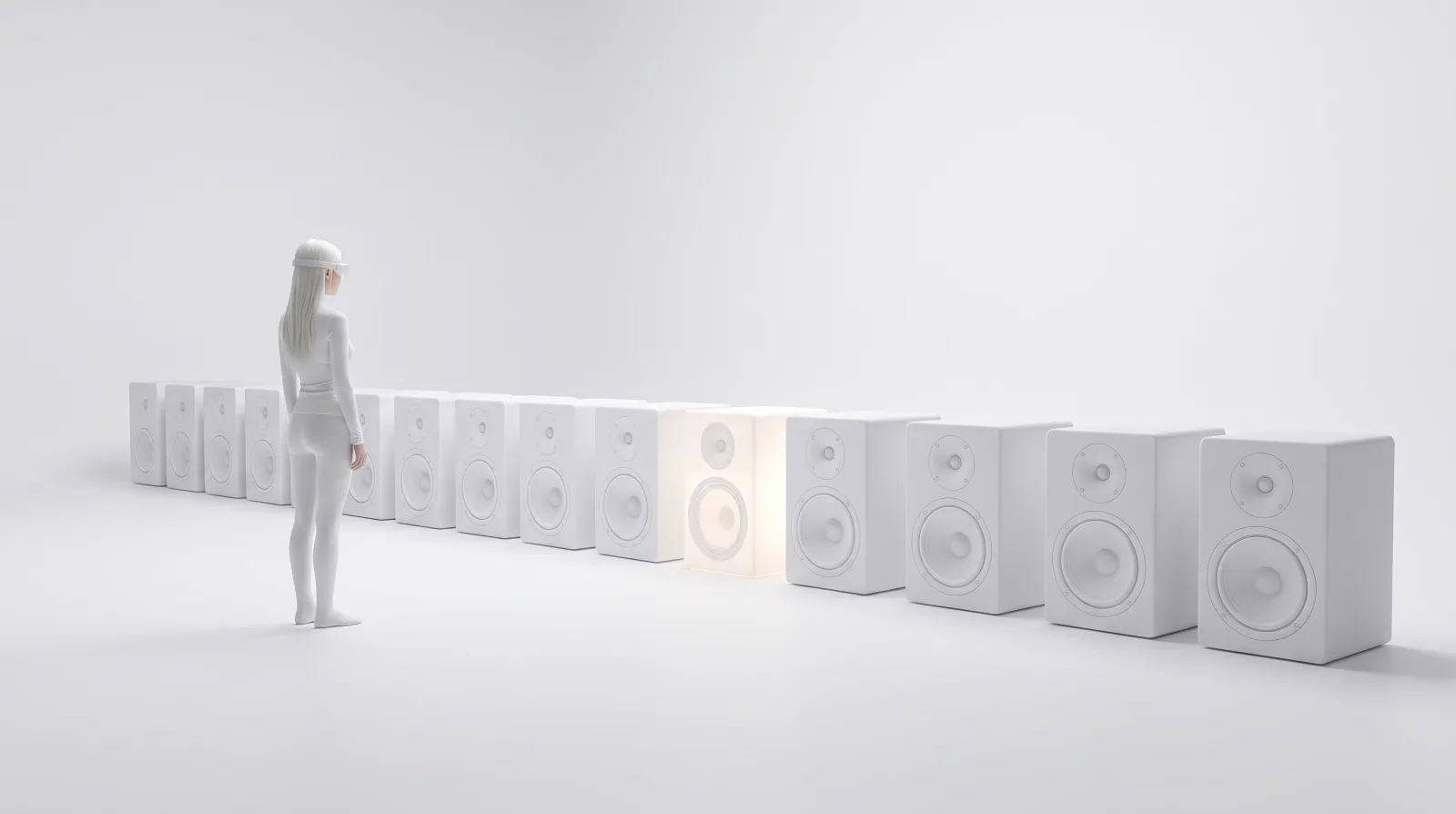
Before ALEX had a voice, thirteen candidates read the same short test text in a single fifty-minute session. Nineteen takes came out of it. Two of the thirteen were deliberately robotic, put in to test whether the format could carry a machine that sounds like a machine. Neither of those won the part. A week later we ran a second round of six takes and marked two of them "more emotional", because the first pass had been accurate and slightly cold.
It is a casting session in every sense a producer would recognise. Everyone reads the same text against the same shortlist, and the decision is made by ear. Candidates differ in how they handle unfamiliar phonemes, where they put stress by default, what happens to their rhythm when a sentence runs long. Those differences decide how much respelling the script needs later, which makes the casting choice and the pronunciation problem one decision taken twice.
The face went through the same process and lost more material along the way. Twenty-five avatar stills were rejected across two visual routes before the host had a look: sixteen on a porcelain route, nine on a silver-woman route. All of that image work matters, and none of it survives the first mangled word.
Almost every line in the final script was recorded twice and both takes were kept. The finale has one. Another three minutes twenty of the same voice narrates the event's video content, so the casting has to hold up well outside the avatar as well.
“The casting choice and the pronunciation problem are one decision taken twice.”
What it does when nobody is talking to it
A character that only exists while it speaks reads as broken the second it stops. ALEX sits out two of the programme blocks entirely, and between cues elsewhere there are stretches where he has nothing to say and the screen is still lit.
Two idle loops were built for exactly that, fifteen seconds each, 9:16, for the vertical screen standing beside the stage. Nothing happens in them. He breathes, shifts his weight, waits. Those loops exist so the character stays alive through the parts of the evening that belong to human speakers, which is most of it.
Alongside the loops, the congress carried fifteen digital twins, described in the programme as living portraits: eight seconds each, square, silent. A silent portrait cannot mispronounce anything, and that is the quiet advantage of the format. It also cannot answer a question. The living portraits and the host were quoted, built and scheduled as two different products.

When the avatar should not open its mouth
Our first client, in 2024, was BoConcept Switzerland, on a direct contract. We built a digital twin of the owner, Flemming Breen-Jensen, master franchise partner for the market, on HeyGen with a clone of his real voice. The twin speaks English, German and French. Flemming does not speak French.
That gap is the case for building one. A man running a business in a multilingual country can address a French-speaking customer in French, in his own voice, without learning the language or hiring a double. The value of the whole project sits in that third language, and the third language is where the pronunciation work gets hardest, because every product name has to survive a French reading as well as a German one.
The same job taught the reverse lesson. One shoot day covered the avatar recording and a photo session, and a separate 42-second commercial in 4K used no twin at all. The narration went to an AI-cast voice from ElevenLabs called Brian, because a brand film wants a narrator and a founder is rarely one. Voice cloning and voice-overs were also done for Helena Christensen's spots under her contract with the brand, and those stay unpublished. Producer credit on the BoConcept work: Allan Nielsen.
At the other extreme sits a job with no script at all. On 18 December 2024, at the Kursaal Arena in Bern, we put a live interactive CEO avatar on stage in front of hundreds of Huawei Switzerland employees, answering questions from the floor in English, German and French. HeyGen again, this time with a trained knowledge base behind it: company facts, colleagues, Christmas jokes. We prepared it over six weeks on a direct contract, with no agency in the middle.
A script that has not been written cannot be phonetically prepared. What we prepared instead was the knowledge base, and the deliverable we still reuse was a document rather than a video: "Instructions for Preparing Data for the CEO Avatar Knowledge Base". Names, product lines and internal abbreviations had to arrive spelled for a reader and spelled again for a speaker. We do not publish client materials from that job without permission, so the method is the part we can show.
Identity can be carried by colour
At the Winter Dealer Conference 2026 in Almaty, delivered with Gubsky Talent Hub, eight AI heads carried eight identities on the LED wall, one colour each. The live speaker delivers a line, the avatar answers, the speaker carries on. Nobody in the hall mistakes that head for a photograph of the person, and nobody needs to. Identity travels by colour, held for the length of the block it belongs to. All eight heads were approved by the speakers themselves, which is the only sign-off that counts on a likeness.
That project answers a question buyers raise early. Speakers accepted heads nobody would mistake for a photograph. None of them would have accepted an answer that arrived late, with the hall watching them stand there waiting for it. Photoreal likeness is worth what it is worth; the timing has no give in it at all.
“A synthesiser will say whatever you spell, in whatever language you spell it, with complete confidence, and it has no idea which of those words your reputation is sitting on.”
What to prepare before you commission one
Five things, and none of them are technical.
Write out every proper noun in the script and record somebody inside your company saying each one aloud: product names, sub-brands, the founder's surname, the city. A few minutes on a phone, and the cheapest insurance in the project.
Name the person who signs off pronunciation. It has to be an ear the company trusts, free on the day, and allowed to say no.
Leave room in the schedule for a casting session and run it as one. Thirteen voices reading the same short test text takes under an hour and decides more than any parameter you will touch afterwards.
Decide what sits on the screen while nobody is addressing the avatar, and how long that state can run before it starts looking frozen.
Collect written consent from every person whose face or voice is used, and settle how the audience is told the speaker is synthetic.
We do not start an avatar project without that list of names and the recording that goes with it. The request looks administrative, and it is the same one a casting director makes when they ask how the lead's surname is pronounced before the first read-through. A synthesiser will say whatever you spell, in whatever language you spell it, with complete confidence, and it has no idea which of those words your reputation is sitting on. Somebody has to know that before the render queue opens. Hire that ear first.
Related: AI and creative work in 2026: three forecasts · How we made a fully AI-generated showreel