
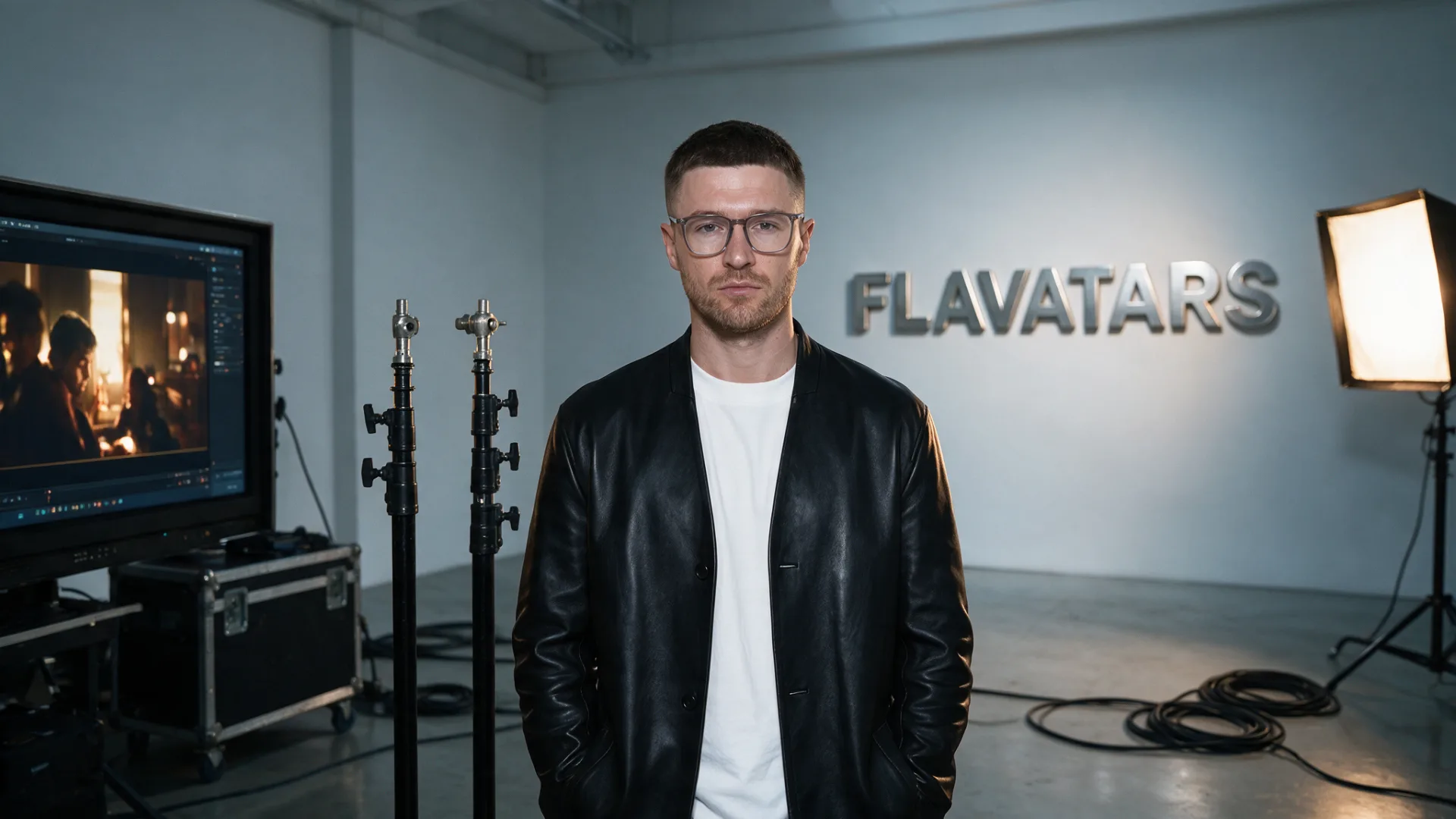
Dario Amodei, Sam Altman and Elon Musk have each put a public timeline on when AI takes over creative work, and they contradict each other on the part that matters most: whether the human in the chain survives. All three are forecasting a room none of them works in. This is what the same question looks like from a studio that ships client work every week, music videos, brand films, national campaigns, without a camera on set.
The short version, from a director who works this way daily
They are arguing about what the machine can do. The harder question is who is qualified to tell it what to do.
A model will execute any cinematic technique you can name. It has never stood on a set, so it does not know which one the scene needs. That gap is not closed by a better model. It is closed by the person writing the instruction.
“They are arguing about what the machine can do. The harder question is who is qualified to tell it what to do.”
What the three of them actually said
Dario Amodei, CEO of Anthropic, was asked directly on the Dwarkesh Podcast (13 February 2026) whether he would rather have a human video editor of six months' experience or an AI of the same. His answer put professional parity at "one to two years, maybe one to three years", and described how it arrives: the model uses your screen, reads your previous work, looks at the history of edits you made, and does the job from that.
He also closes the argument most people lean on. Visual defects, the wrong number of fingers, the melted hands, "get addressed quickly, often within just a few months." Quality artifacts are not a moat.
And in The Adolescence of Technology (January 2026) he addresses the human-touch defence directly: "perhaps some tasks inherently require or greatly benefit from a human touch. I'm a little more uncertain about this one, but I'm still skeptical that it will be enough to offset the bulk of the impacts I described above."
Sam Altman, CEO of OpenAI, says close to the opposite about people. At the Breakthrough Prize ceremony in Santa Monica (18 April 2026): "people will care more about humans and more about human creators in the future, not less." In The Gentle Singularity he adds the qualifier that most coverage cuts: "A lot more people will be able to create software, and art. But the world wants a lot more of both, and experts will probably still be much better than novices, as long as they embrace the new tools."
In May 2026 he went further and retracted his own displacement forecast: "I'm delighted to be wrong about this, I thought there would have been more impact on entry-level white-collar jobs being eliminated by now than has actually happened."
Elon Musk has been the most specific and the least delivered. In October 2025: "Grok will make a movie that is at least watchable before the end of next year and really good movies in 2027." In July 2026 he promised a full-length, historically accurate Odyssey from Grok Imagine before the end of the year. As of late August there is no announced director, no runtime, no release date and no footage beyond a three-minute demo.
His view of what remains for people came in his Economist interview (23 July 2026): work becomes optional, like gardening. You can buy pristine vegetables at the store, or grow your own, and yours will be less perfect. "If you go to a friend's house and they make dinner with vegetables from their garden, it's a nice touch. That's what work is going to be like."
Where they disagree, and why it matters
The three agree on exactly one thing: the timeline. Professional-grade capability inside 24 to 36 months, and current visual defects are not what stands in the way.
They disagree completely on the human being. Amodei doubts that being human is, by itself, protection. Altman says audiences will value human authorship more, not less. Musk says human work survives as a nice touch, a homegrown tomato, valued because a person made it, not because it is better.
That third position is the one worth arguing with, because it quietly concedes that human work becomes worse and sentimental. In our field that is not what is happening.
Two numbers from 2026 sit awkwardly against all three. UK creative agencies cut headcount by 14.3% over the year, and roles for under-25s by 19.2% (IPA Agency Census, published February 2026), so displacement is real. But Gartner's 2026 CMO Spend Survey found AI at 15.3% of marketing budgets while labour's share of those budgets rose, from 21.9% to 24.5%. Spending on people went up, not down, in the same year that AI spend arrived.
“It is not whether the human touch survives contact with the machine. It is whether there is still someone in the room who knows what to ask for.”
What this looks like from inside a production
I have spent fifteen years on real sets, music videos, commercials, film, and the last five working with generative models every day. That combination is the reason our showreel exists: two minutes twenty-six seconds, around 110 cuts, every frame generated including both presenters, and not one camera.
It is also why the work has not slowed down. Fourteen finished pieces went out to clients in the last week alone, and the studio is currently in production on a large television project for Kazakhstan. None of that is a demo reel. It is delivery, on deadline, to brief.
Here is what the forecasts miss.
The model will execute any cinematic technique you can name. It does not know which one the scene needs. That judgement comes from having stood on sets: knowing what a 35mm lens does to a face that a 50mm does not, what a handheld shot gives a scene that a stabiliser takes away, how light reads when it is motivated by something inside the frame instead of pointed at the actor. Without that vocabulary you cannot give a model a precise instruction, and an imprecise instruction returns the average of everything the model has ever seen. That average is what people call AI slop. It is not a model failure. It is an instruction failure.
This is also why people arriving from outside film production get a different result. Not a worse one, a different one. They are drawing on a different set of references, so the work lands somewhere else. The gap is not talent. It is vocabulary.
And it is why the model cannot close the gap on its own. It has never been on a set. If it ever does make these decisions unaided, it will be because someone encoded the craft into it, which still requires people who hold that craft.
So the question the three of them are arguing is the wrong one. It is not whether the human touch survives contact with the machine. It is whether there is still someone in the room who knows what to ask for.
“An imprecise instruction returns the average of everything the model has ever seen. That average is what people call AI slop.”
What we would tell a brand right now
Three practical positions we hold, and would defend.
Direction is upstream of generation. Every shot in our reel was a shot before it was a prompt: framing, lens, light and blocking decided first, model asked second. Reverse that order and you get a folder of impressive fragments that refuse to sit next to each other.
The cost did not disappear, it moved. Generation is fast and cheap. Selection, continuity and rejection are neither. Most of the work in a finished AI film happens before and after generation, not during it.
Disclosure is not a risk, it is the plot. Our showreel opens as a game, guess which shots are real, and reveals at 2:12 that none of them are. Under Article 50 of the EU AI Act, in force since 2 August 2026, that disclosure is also an obligation. It cost us nothing and it is the most-quoted thing about the film.
We are not in a position to argue with three of the most influential people in the industry about where the technology goes. We are in a position to say what it does when you point it at a real brief, and to disagree in public, with our name on it, when the view from the cutting room does not match the view from the keynote stage.
Oleg Pylypenko, director and founder of Flavatars. Fifteen years in production, 50+ music videos, 500M+ views; directed the AI Showreel 2026, a 2:26 film in which every frame, including both presenters, is generated.
Related: How we made a fully AI-generated showreel · Cinematic AI video vs generic AI slop