
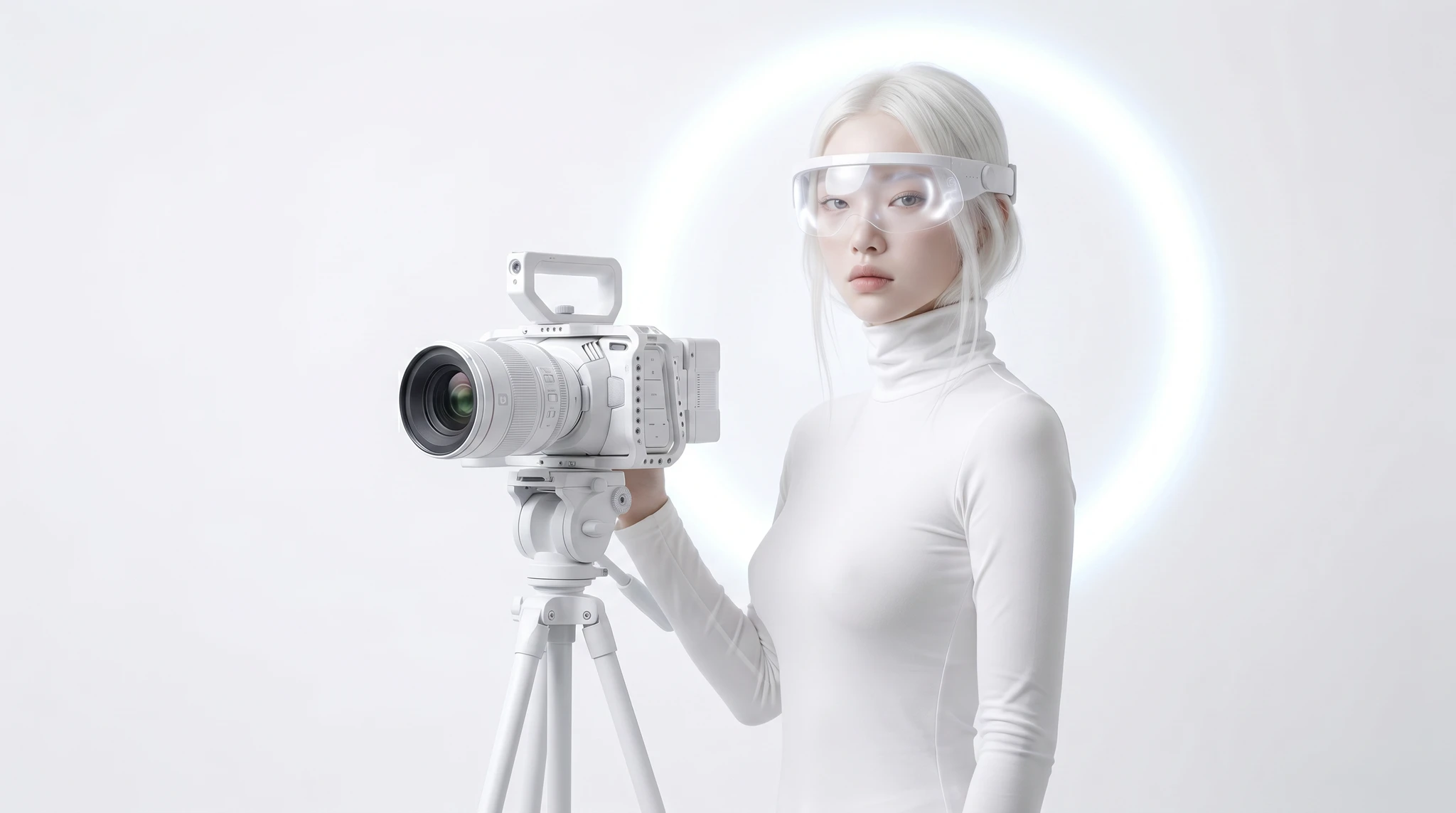
Cinematic AI video and generic AI slop can come out of the same model on the same day. The difference is not the tool — it is direction, taste, real references, and a human who throws away the bad takes. At Flavatars, an AI-Driven Creative Agency run by director Oleg Pylypenko with 15+ years in film production, we treat AI as a camera, not an author. This is what separates a shot that holds a room from the soft, forgettable footage flooding every feed.
Why most AI video looks the same
Open any feed and you can spot it in a second: the soft plastic skin, the drifting camera that never commits to a move, the golden-hour light that means nothing, the subject centred and static. This is AI slop — not because the model is weak, but because nobody made a single decision. A prompt went in, the default came out, and the default is an average of everything the model has ever seen.
Averages look the same by definition. When you ask a model for 'a cinematic shot of a woman in a city,' it gives you the mean of a million cinematic shots of women in cities. No lens choice, no reason for the light, no story in the frame. Millions of people are typing near-identical prompts into the same handful of models, so the output converges. That convergence is the slop.
The fix is not a better prompt. It is a decision. Every frame that reads as cinematic exists because someone chose the lens, the light, the blocking, the grade, and the cut — and rejected the twenty versions that were merely fine.
“Averages look the same by definition. That convergence is the slop.”
What makes AI video cinematic: direction over prompts
Cinematic AI video is directed, not generated. Direction means intent behind every choice on screen: why the camera moves when it moves, where the light comes from and what it hides, how the shot is framed and cut against the one before it. A model can execute any of these. It cannot decide which one serves the story, because it does not know the story.
In practice, direction shows up as constraint. A director says the lens is a 35mm, the move is a slow push, the light is a single hard source from frame-left, the grade is cold with a warm skin lift. Those constraints are what pull the output away from the average and toward something specific. Generic AI video is generic precisely because it refuses to constrain anything.
This is the difference between a tool and a studio, and it is why we treat the model the way a cinematographer treats a camera body — a means, not the maker. The taste sits with the person, not the software. You can read more about that split in our note on an AI studio versus an AI tool.
Taste and craft: the human quality control loop
Taste is the ability to look at ten near-identical outputs and know which one is right — and to bin the other nine without hesitation. It is the least automatable part of the pipeline and the part that decides whether video reads as premium or as slop. Models generate abundance. Craft is what you keep.
Our loop is unglamorous. We generate wide, we cull hard, we re-shoot the misses, we grade for continuity, and we cut for rhythm the way you cut live footage. A raw generation is a rough take, not a final frame. On our neural VFX work for the feature film Khreshchatyk 48/2, that discipline is the whole job: the AI does the impossible shot, but a human decides, frame by frame, whether it holds up on a cinema screen.
The uncomfortable truth is that most of the quality lives in what you throw away. A studio that ships its first generation is not directing — it is gambling. Human quality control is the difference between a lucky frame and a reliable result.
“Most of the quality lives in what you throw away.”
Real references beat vague prompts
Vague prompts produce vague video. 'Cinematic, moody, high-end' means nothing to a model because it means everything. The way you pull output away from the average is with real references: a specific film still, a lighting diagram, a lens, a colour palette, a brand's own footage, a LoRA trained on the actual product or artist. Precision in equals precision out.
This is where a real director's fifteen years of film references earn their keep. Naming the exact reference — a particular DP's contrast, a specific film's grade, a real location's light — collapses the possibility space from a million average shots to the one you actually want. Brands rarely have that vocabulary on hand. Supplying it is a craft skill, not a prompt trick.
References also lock a brand's identity in place across dozens of shots, which no default prompt can do. That consistency — the same face, the same product, the same world, take after take — is what separates a campaign from a pile of clips.
Cinematic AI video in real work: Maroko, Munisa, Khreshchatyk
The proof is in music video and film work, where audiences are unforgiving and slop gets noticed instantly. On Maroko's «Ojalá», the job was a coherent visual world across every cut, not a reel of impressive-looking fragments. AI generated the impossible imagery; direction made it one film. You can see it in our case for Maroko «Ojalá».
The same discipline stands behind Munisa Rizayeva's «Oka» — 73 million views, shot for real with no AI in the frame. AI worked where it belongs on a classic production: in pre-production, generating the cinematics and the director's documentation that went to every department before the cameras rolled. Our work on Munisa Rizayeva «Oka», directed and written by Oleg Pylypenko in 2025, is the proof that the direction behind our AI work comes from a real set — the craft is the same; only the camera changes.
And on the feature Khreshchatyk 48/2, neural VFX had to survive the big screen alongside conventional footage. Our Khreshchatyk 48/2 film VFX shows the ceiling of the approach: when a director controls the pipeline, AI video stops being a novelty and becomes a shot in a film.
How brands get cinematic AI results instead of generic ones
If you want the cinematic result rather than the generic one, the shortest path is to change what leads the process. Slop happens when the tool leads. Craft happens when a director leads and the tool follows. That reordering is the entire difference, and it is the reason a studio exists.
Concretely, that means locking references and a visual bible before a single frame is generated, choosing lens, light and movement on purpose, generating wide and culling hard, grading for continuity across every shot, and putting a human eye on the final cut. None of those steps is exotic. Together they are the reason one video looks directed and another looks defaulted. Our AI Video & Film Production runs exactly this pipeline for brands and artists.
The math also favours it. AI collapses the cost of shots, so the budget that used to buy one polished asset now buys many directed ones. The constraint is no longer money or render time — it is taste and direction, which is precisely what a studio brings and a tool cannot. When your output starts looking like everyone else's, that is the signal to start a project with a director in the loop.
Cinematic vs generic AI video: a plain checklist
If you need a fast test for whether a piece of AI video is cinematic or slop, run it against a handful of decisions. Cinematic footage answers each one; generic footage answers none.
Ask of any shot: Is there a reason for the camera move? A single, motivated light source? A lens choice you could name? Consistent identity across shots? A cut that means something? Real references behind it, not adjectives? A human who saw ten versions and chose this one? Slop fails these because no one ever asked the questions.
The checklist is really a proxy for one thing: was there a director. Everything cinematic traces back to a person making choices and rejecting the average. Everything generic traces back to a prompt left to decide for itself.
Related: An AI studio versus an AI tool · The best AI video studios in 2026