

The Flavatars AI Showreel 2026 is a 2-minute-26-second film in which every single frame is AI-generated: the worlds, the boxing match, the revolver, the studio, and both people presenting it. Around 110 cuts are locked to the beat of an original track, and the whole thing opens as a game — guess which shots are real. Directed by Oleg Pylypenko, a film director with 15+ years on real sets, it was built with Seedance 2.0 and Seed-Audio 1.0 on ByteDance's enterprise stack. This is how it was made, decision by decision.
The brief we gave ourselves: a reel that argues
A showreel is supposed to prove competence. Ours had a harder job: it had to retire a question. Every client conversation about AI video eventually reaches the same point — 'but does it actually look real?' We decided the reel itself should answer, so it opens as a game. A narrator invites you to guess which shots are filmed and which are generated. You watch 2 minutes and 26 seconds of film worlds, music worlds and brand worlds, and you make your guesses.
The answer arrives at 2:12, and it is the same answer for every shot: all of it is generated. The boxing match, the revolver, the studio, the war-torn streets, the neon dance floors — and both presenters. The founder's AI avatar and the studio's muse walk you through the film, and neither of them exists. Even the reveal is part of the argument: the disclosure is the plot.
That structure did more for us than any claim could. A viewer who plays the game and loses it stops asking whether AI can look real. From that moment the conversation is about what to make, which is the conversation we want. You can watch the film on its own page — the AI Showreel 2026 — before reading how it was put together.

“A viewer who plays the game and loses it stops asking whether AI can look real.”
Directed first, generated second
Every shot in the reel was a shot before it was a prompt. Framing, lens, light and blocking were decided the way they are decided on a set — on paper, with references, against the cut that would follow. Only then was the model asked to execute. That order sounds like a detail. It is the entire method.
When generation leads, you get a folder of impressive fragments that refuse to sit next to each other: mismatched light, drifting cameras, no reason for any cut. When direction leads, the model becomes what a camera is to a cinematographer — a means of execution with taste sitting outside it. We wrote about that split in more depth in our note on cinematic AI video versus generic slop; the showreel is that argument at feature intensity.
The practical consequence: most of the work happened before and after generation, not during it. Shot lists, reference boards and a written dramaturgy came first. Then generation, wide. Then the part nobody sees — culling hard, regenerating misses, and grading for continuity so 110 cuts from dozens of separate generations read as one film stock, one world, one film.

The beat grid: ~110 cuts that land on the track
The reel runs 2:26 and holds roughly 110 cuts. None of them is placed by feel alone. The track was analysed for its beat grid first, and the grid became the skeleton of the edit: every cut lands on a beat, the big reveals land on the phrase boundaries, and the tempo of the cutting accelerates exactly where the music does.
This is the least glamorous decision in the project and the most important one. A montage of AI clips usually reads as a slideshow because the cuts obey the clips — each shot overstays until its generation runs out. Locking the edit to the music inverts that: the track decides how long a shot may live, and the shot is trimmed or retired to serve the rhythm. The result reads as one film with a pulse instead of a folder of renders.
Beat-locking also disciplined the generation itself. Knowing a shot would live for 1.2 seconds changes what you ask for: one readable action, one direction of movement, no second beat. Shots built as moments cut cleanly; shots built as little films do not. We generated for the edit, not for the gallery.
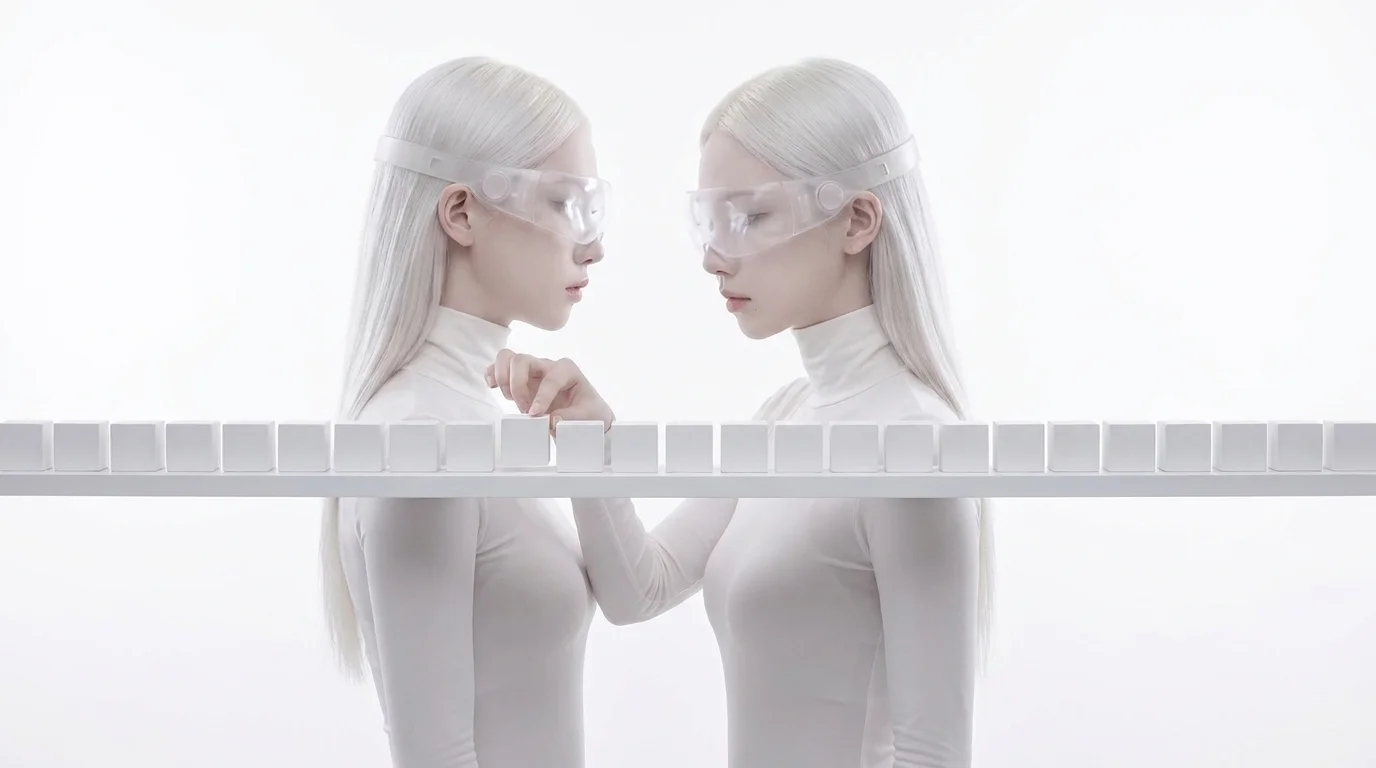
“The track decides how long a shot may live.”
The Kuleshov pairs: meaning lives in the edit
Nothing in the reel is narrated in the conventional sense. There is no voiceover explaining what you see. Meaning is assembled the way cinema has assembled it for a century — through the Kuleshov effect, where a look in one frame explains the action in the next. A fighter glances off-screen; the cut shows what he fears. The revolver rises; the cut answers it.
For AI footage this is not a stylistic preference, it is a survival strategy. Individual generated shots carry no memory of each other, so continuity of meaning has to be manufactured between them. Ordering shots into pairs and triads — setup, glance, payoff — gives the audience causality the footage itself never contained. The viewer's brain does the compositing.
This is also where fifteen years of real sets pay their rent. Knowing which two shots create a third meaning when butted together is editing-room craft, not model knowledge. The models delivered the frames; the dramaturgy — three acts, film worlds into music worlds into brand worlds, ending on one last fight — came from the cutting room.
The stack: Seedance 2.0 and Seed-Audio 1.0, run directly
The imagery was generated in Seedance 2.0 and the narrator's voice in Seed-Audio 1.0, both on ByteDance's BytePlus enterprise console. We run the stack directly rather than through a wrapper, which matters for one unglamorous reason: identity. Keeping a character's face, wardrobe and physics consistent from shot to shot takes reference control that consumer front-ends do not expose.
The two presenters are the hardest case in the film. The founder's AI avatar and the studio's muse appear across multiple shots, angles and lighting setups, and they have to remain themselves in every one — the game collapses the moment a face drifts. Reference packs, locked identity markers and ruthless rejection of near-misses held them together.
The same discipline ran through the sound. The narrator who runs the game is generated, scripted line by line with timed delivery, and the music is an original track by GADZZ whose grid drove the entire edit. Nothing in the pipeline was left on defaults, because defaults are where generated work starts looking generated. The full pipeline is the same one behind our AI video production work for brands and artists.

What the numbers say
The reel's claim is checkable, so here are the numbers behind it. Runtime: 2 minutes 26 seconds, one unbroken film. Cuts: around 110, each on the beat grid of the track. Cameras used: zero — no sets, no crew, no shoot days. Presenters on screen: two, neither of whom exists. The reveal lands at 2:12, and the film has been public on YouTube since late July 2026.
Behind those numbers sits a studio, not a person with a subscription. Flavatars was founded by Oleg Pylypenko after 15+ years in film production, 50+ music videos and 500M+ accumulated views. The showreel compresses that background into 146 seconds: the taste was trained on real sets, and the models are the newest camera it points.
What the numbers do not show is the rejection rate. For every shot in the film there were generations that looked fine and died anyway — for the wrong movement, the wrong light, a face two percent off. That invisible pile is the actual cost of the reel, and the reason it reads as directed rather than assembled.
“The taste was trained on real sets. The models are the newest camera it points.”
What this means if you have a brand
The showreel is a proof, and the proof transfers. If a two-and-a-half-minute film can be generated end to end — identity held, edit on the beat, meaning built in the cut — then a product film, a campaign, a music video or a brand world can be built the same way. The constraint is no longer cameras or budgets. It is direction.
That changes the shape of what a brand buys. Instead of one polished asset per quarter, the same discipline produces families of directed footage: variations for markets, formats and tests, all holding one identity. Our Zeely AI collaboration runs on exactly that logic at production scale, and the showreel is the open-source version of the argument.
If the game got you — if there was a shot you would have sworn was filmed — that is the conversation starter. Tell us what you would put on screen, and we will tell you honestly what the pipeline can and cannot do for it. The film is on the showreel page; the door is the contact form.
Related: Cinematic AI video vs generic AI slop · An AI studio versus an AI tool