
Work · Concert visuals · Tashkent, September 2025
Lola — «O‘zicha KONSERT»
For five nights the screen behind Lola was not a screen. It was a character with its own arc: it wakes, it reads a century of us, it takes the artist, it gives her back — and then it tells us what it saw.
- 5
- nights, 26–30 September 2025
- 4
- films written as one character
- 7:01
- of screen time, all in 4K
- 3 months
- the key art ran before the show
In short
Flavatars produced the stage films for Lola’s «O‘zicha KONSERT» — five nights at the Palace of Friendship of Peoples in Tashkent, 26–30 September 2025. Four films, 7:01 of 4K screen time, built on one premise: the stage is a system with its own AI. It boots, reads a century of human history, absorbs the artist, recharges her with light, and delivers a verdict. We also animated the concert key art that opened the campaign three months earlier. Production — Gubsky Talent Hub, director — Serhii Human.
The premise
The stage was written as a character
The director’s idea was not a set of clips for the screens. In the story of the show the stage has its own intelligence: it has been switched off for a long time, it boots badly, it hears the music, and it answers. Everything that appears behind the artist is that system thinking out loud.
That turns four separate videos into one dramatic line. The audience meets the system at its most curious and leaves it at its most disillusioned — and Lola crosses that line as both its subject and its reason. The reference the director kept returning to was Leeloo reading human history in «The Fifth Element»; for the finale, «Earth Song».
Act I
0:19 · 4K
Boot
The system wakes after a hundred years and tries to catch up in nineteen seconds.
The show opens on a stage that does not work yet. The signal tears, the frame rolls, analog interference eats the picture — the director wanted the failure of an old broadcast, not the tidy square pixels of a modern glitch.
Then the archive breaks through. First love, children running, friends meeting at a station, a rocket leaving the pad, the first computers, a server hall, Uzbekistan’s national team, the Earth from orbit. Nineteen seconds of human history, compressed to the speed of a machine reading it.
Act II
3:15 · 4K
Awakening
Lola wakes inside the machine, finds its core, and the core takes her.
A dark chamber of cables and cold neon. Lola comes round in a chair she does not recognise, walks the room, and finds a sphere on a pedestal — the heart of the system, dormant until she is close enough.
She touches it. The room falls away and the camera is pulled inside: a tunnel of data, a fractal field, the mother network. Her skin turns translucent, the currents run under it, and the body dissolves into the machine until only a digital face is left — then nothing.
Act III
2:53 · 4K
Recharge
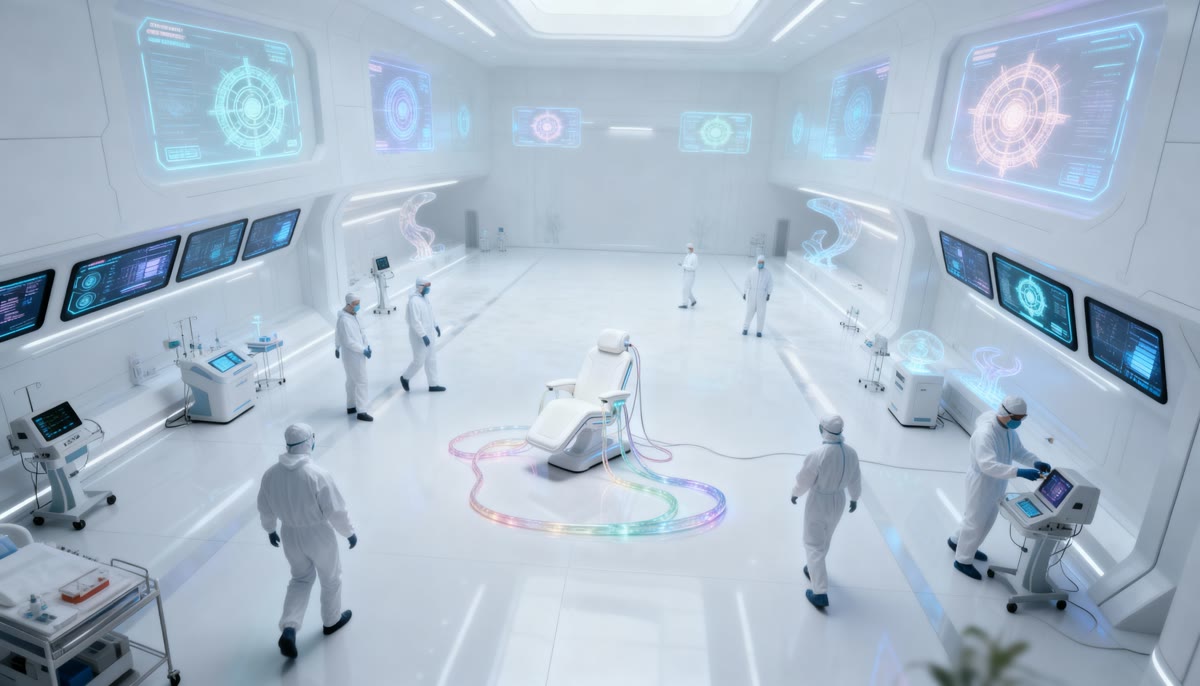
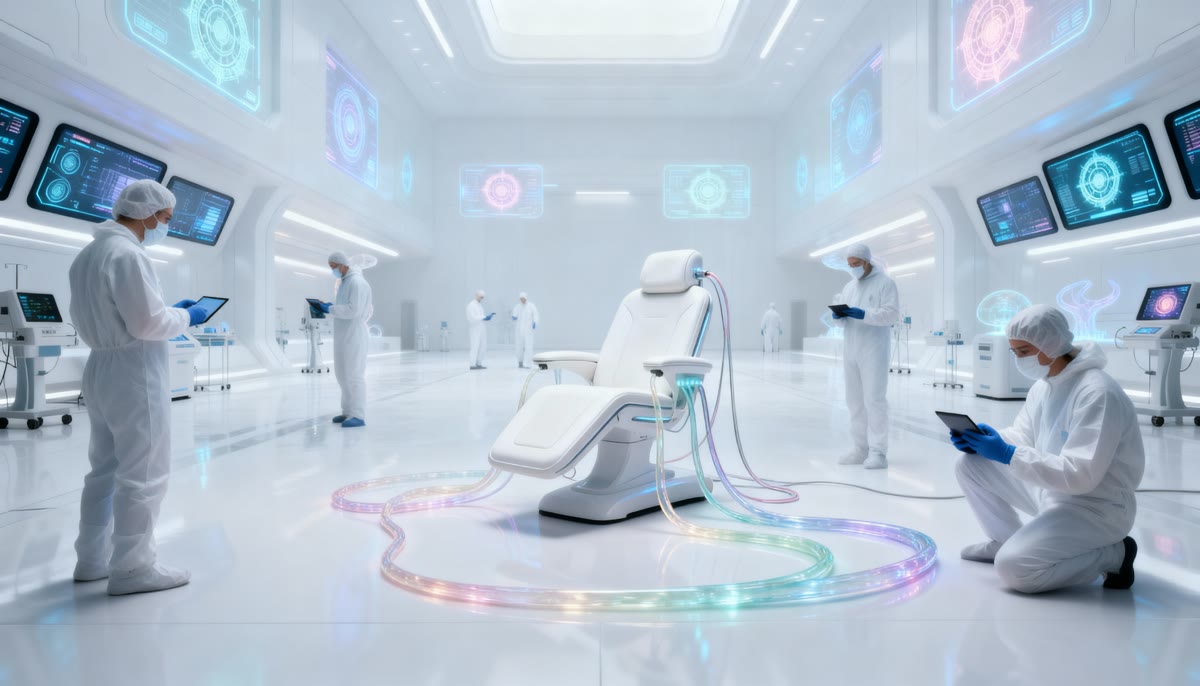
The opposite world: a white laboratory where she is filled with light, not electricity.
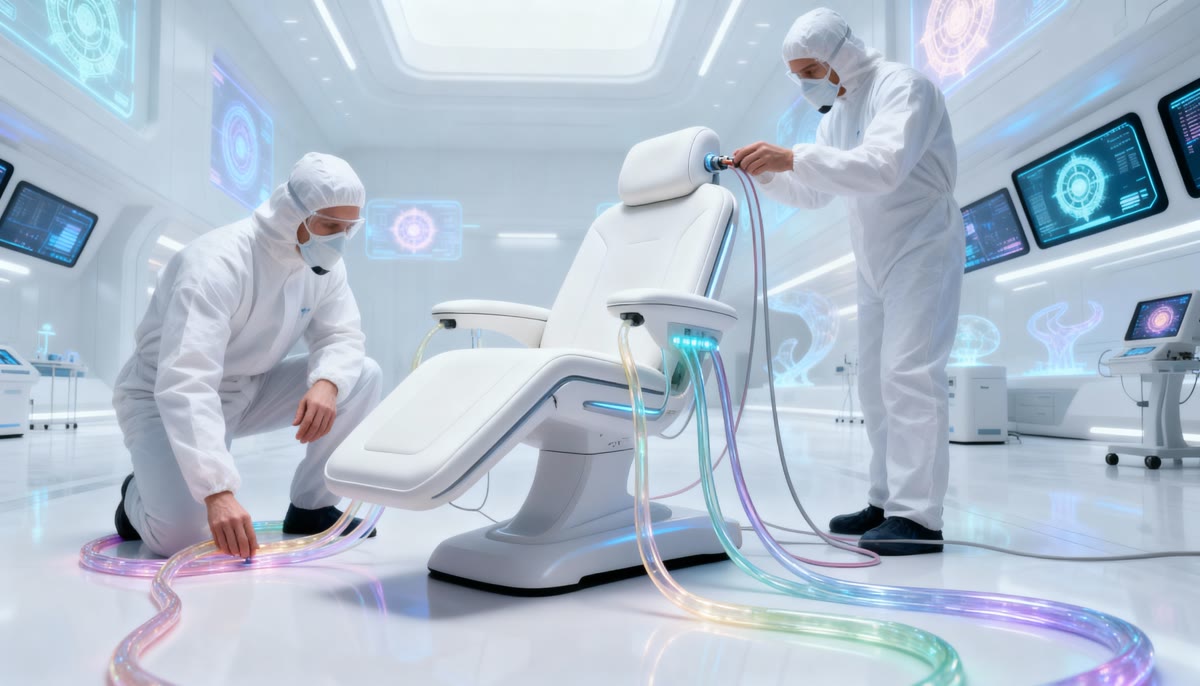
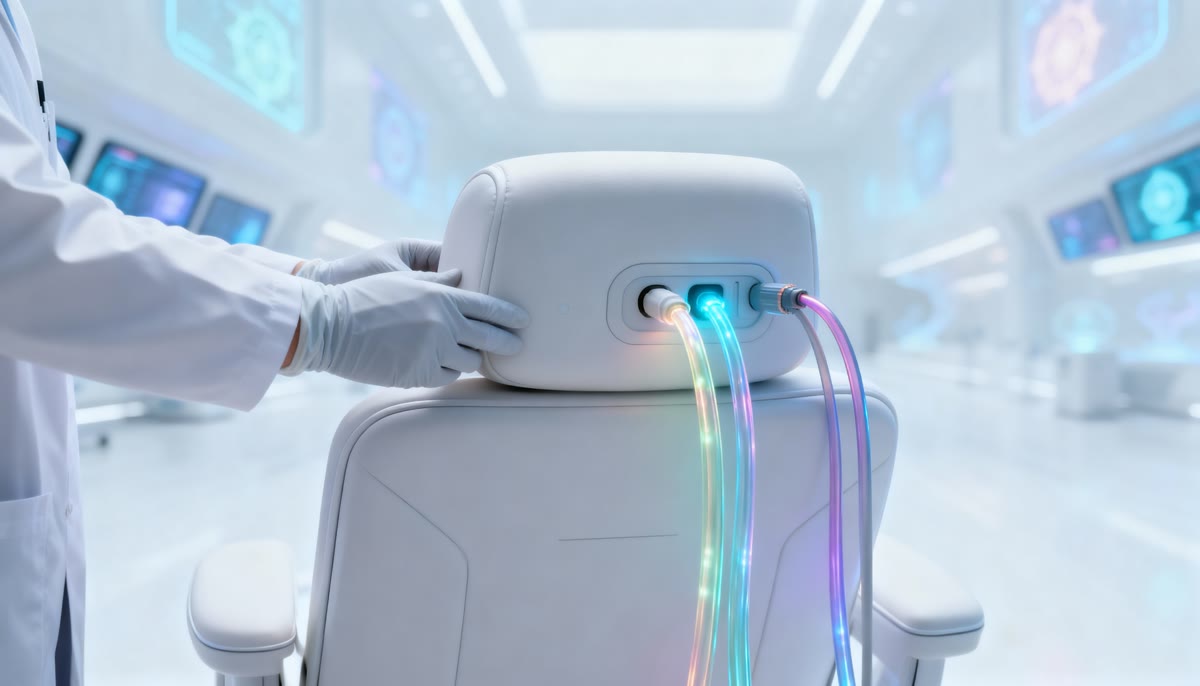
Behind the stage she walks a bright corridor into a research hall. A chair without a headrest, a neural connector at the base of the neck, translucent cables carrying the seven colours of the chakra system. Technicians in clean-room suits prepare the system while she arrives.
The charge is a metaphor, and the film says so: what enters her is not power but clear thought. Halfway through, the laboratory gives way to a meadow — a bird, white flowers, a hand across the petals, clouds running over a bright horizon. The technical procedure becomes a meditation.
Act IV
0:33 · 4K
Verdict
The same system looks again — and reaches the opposite conclusion.
The finale mirrors the opening. Fire in the forest, a building coming down, oil on the feathers of a bird, flood water at chest height, a crowd that argues, a street where everyone is looking at a screen while the world burns behind them.
It is cut as news, not as cinema: raw handheld camera, flat light, ungraded colour — the look of footage found in an archive rather than staged for a stage. The system that opened the show in wonder closes it with a warning.
The hard constraint
One face, held across every frame
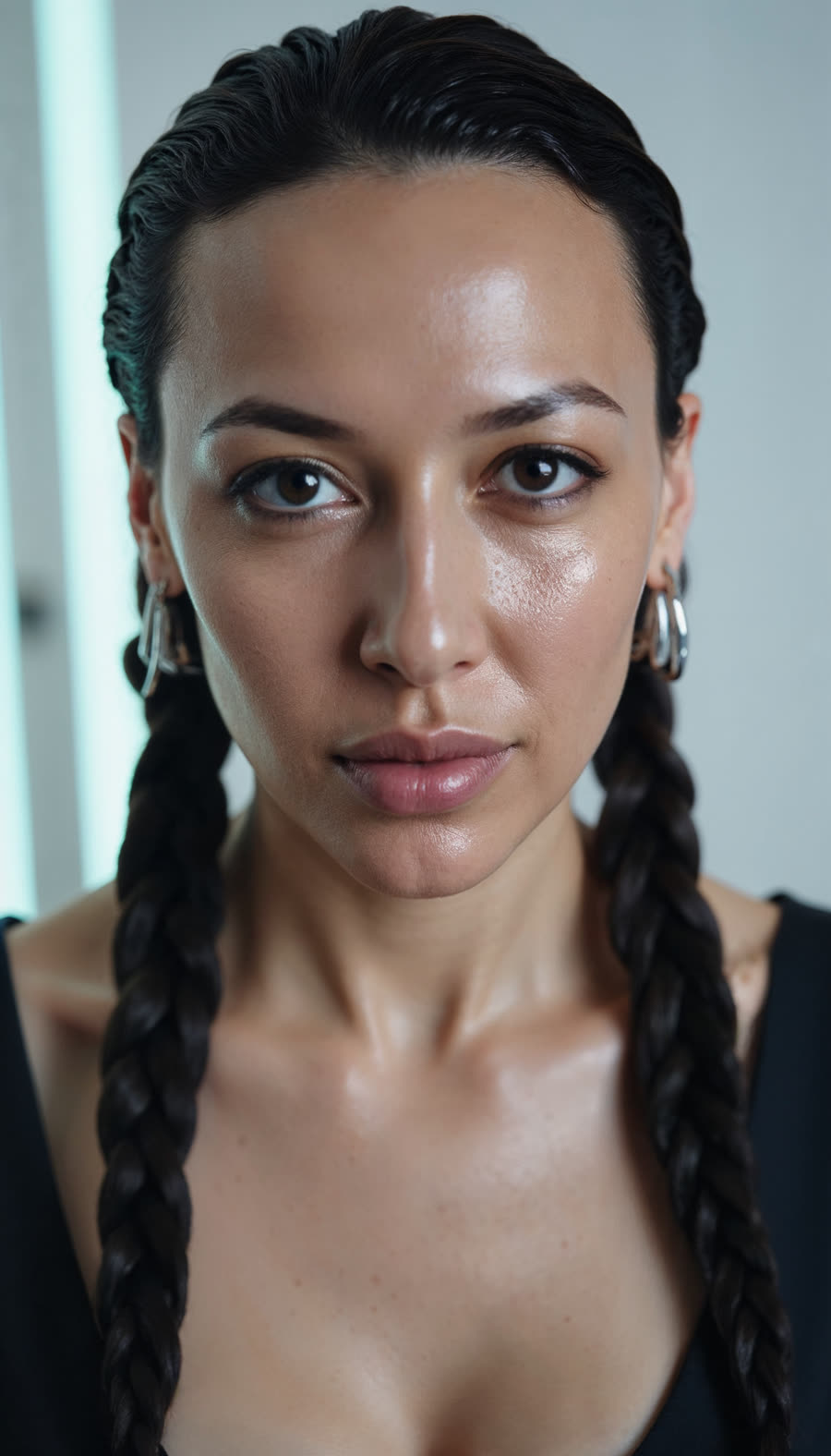
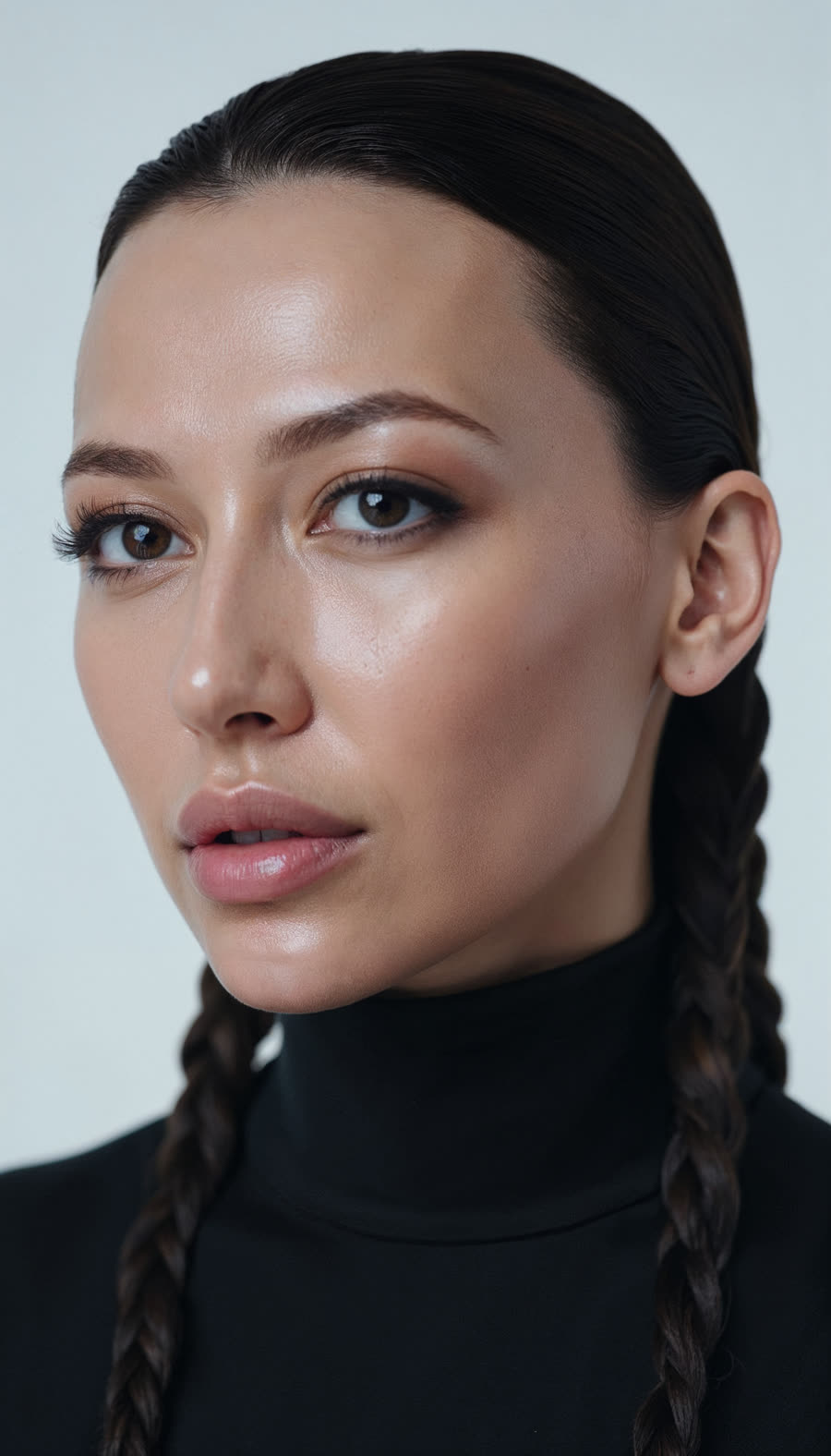
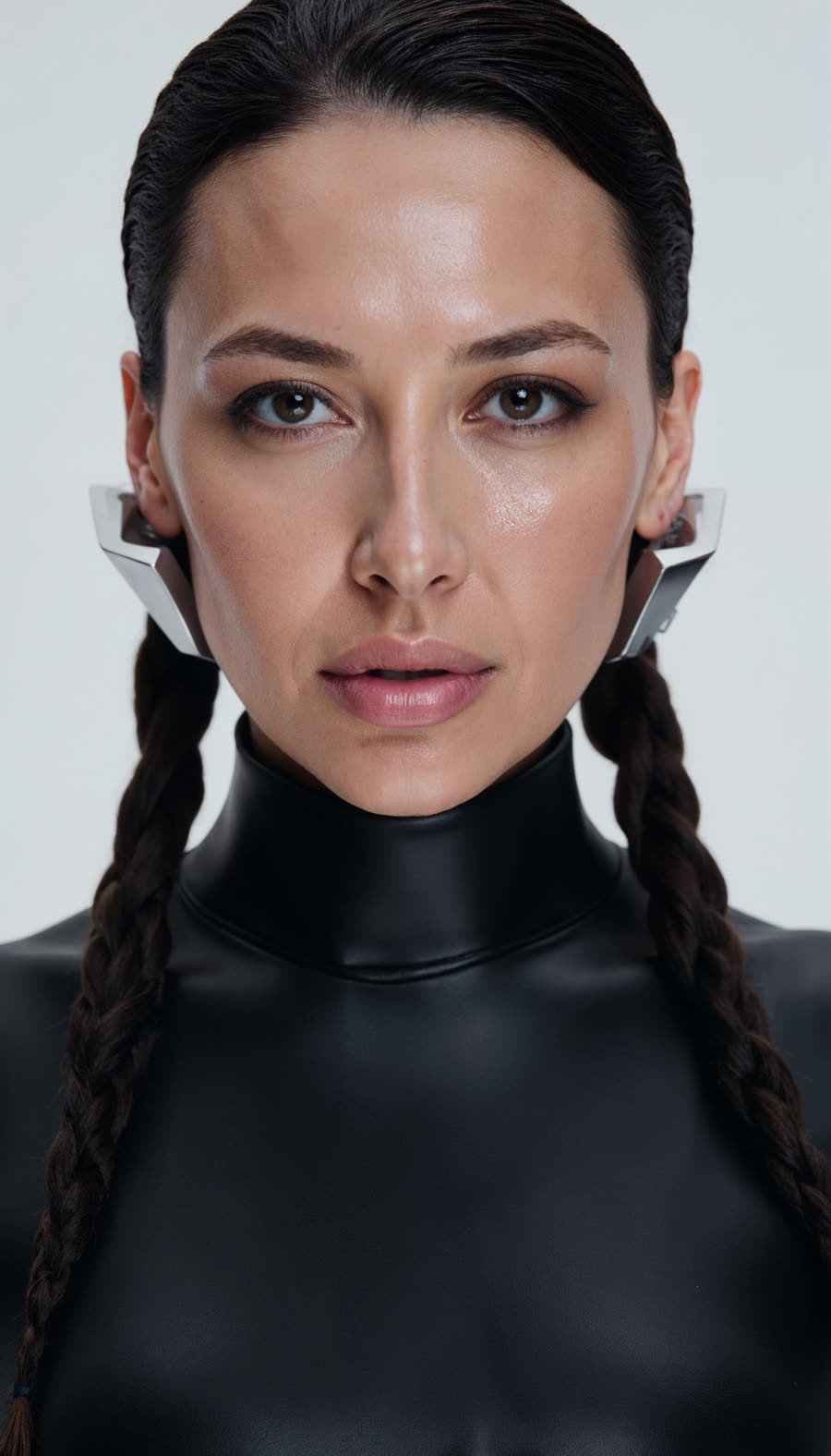
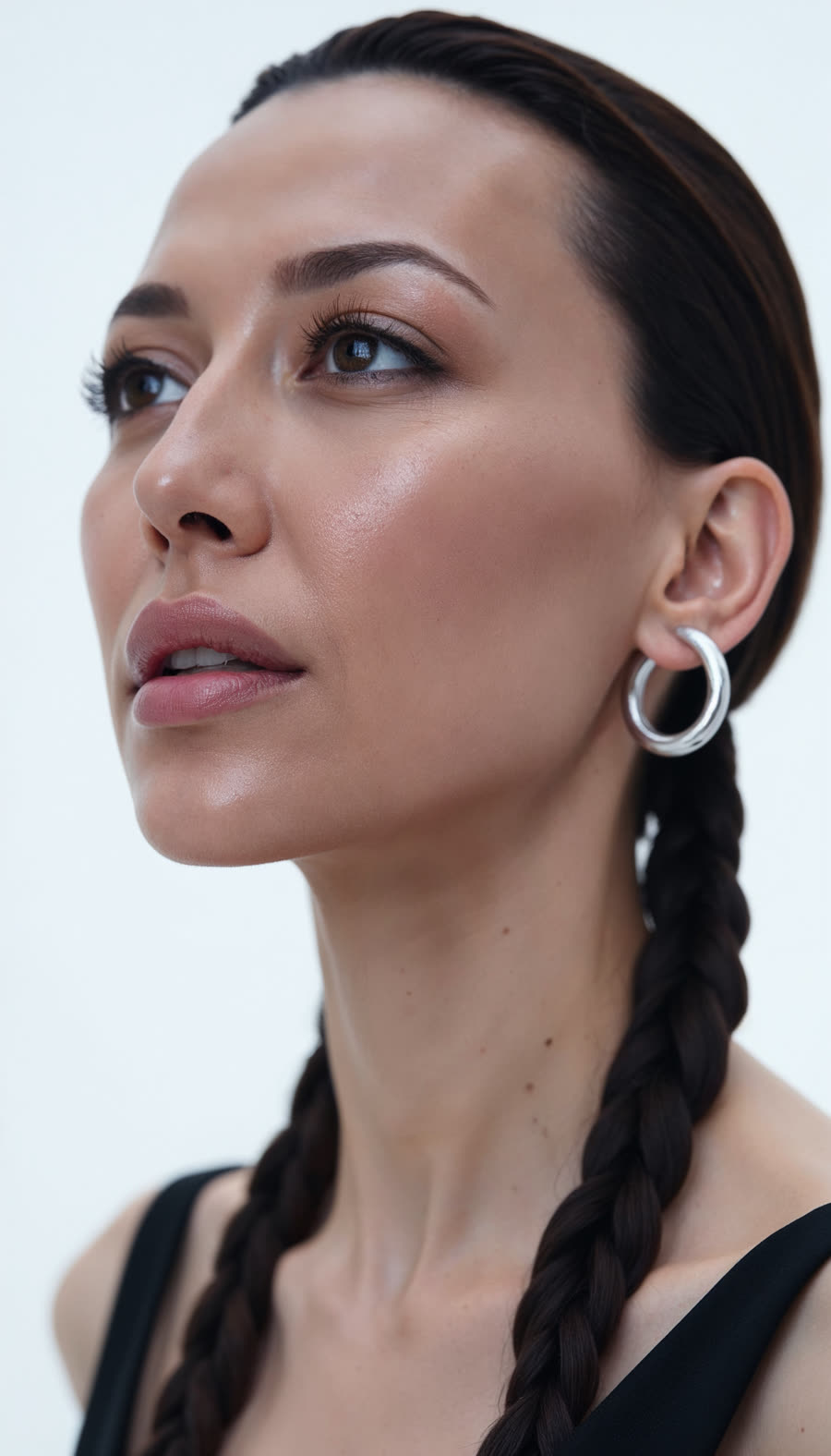
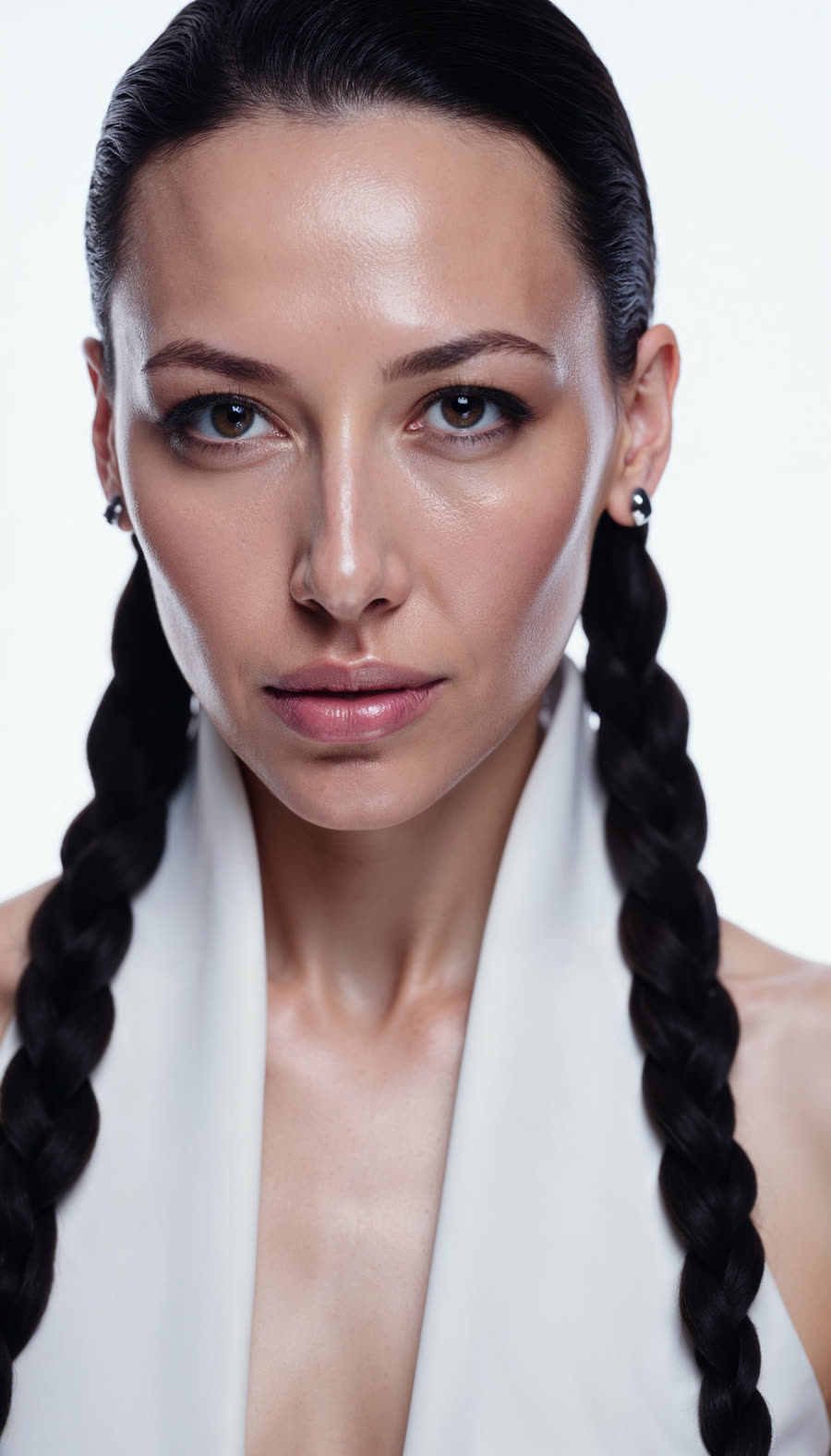
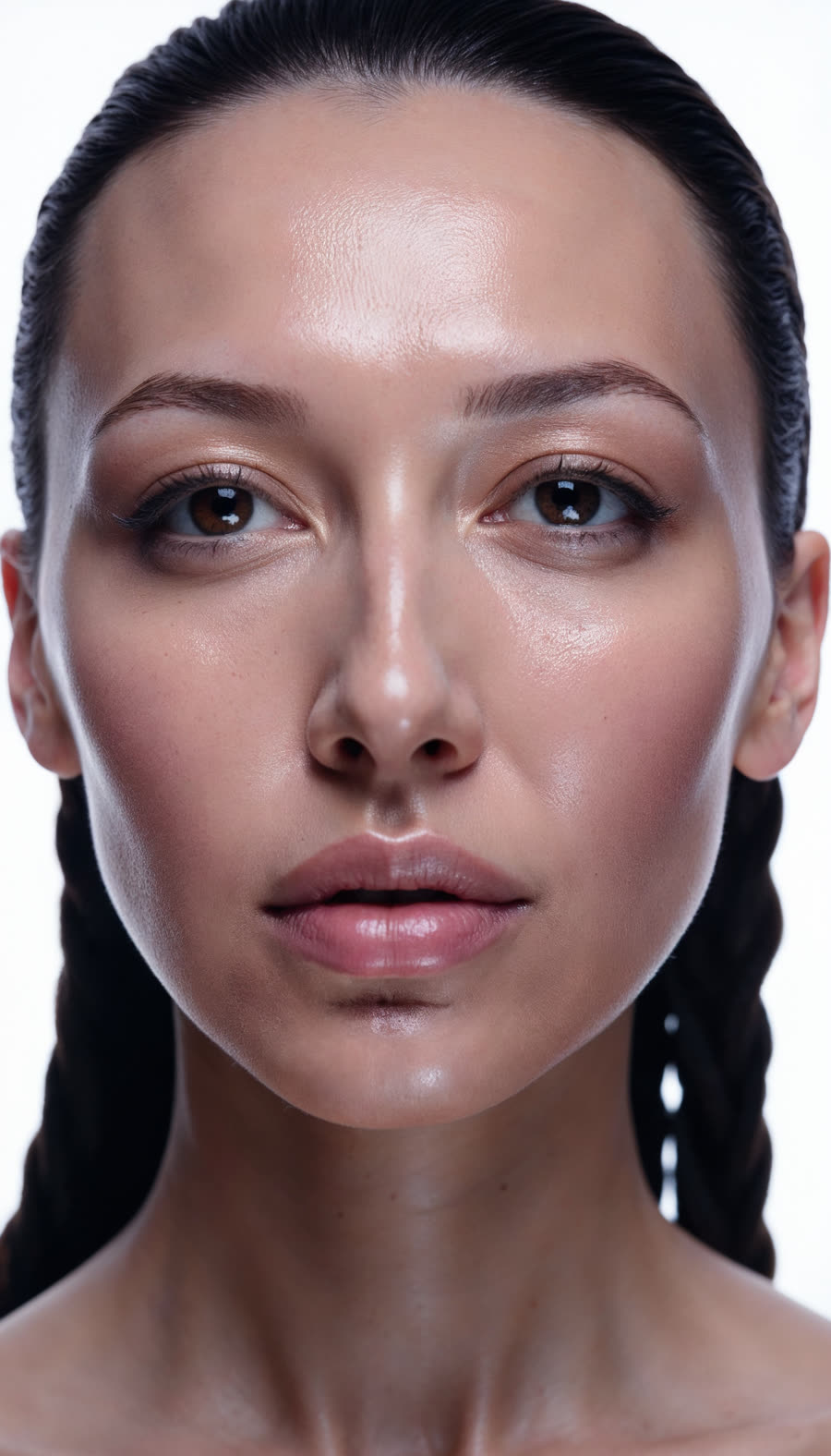
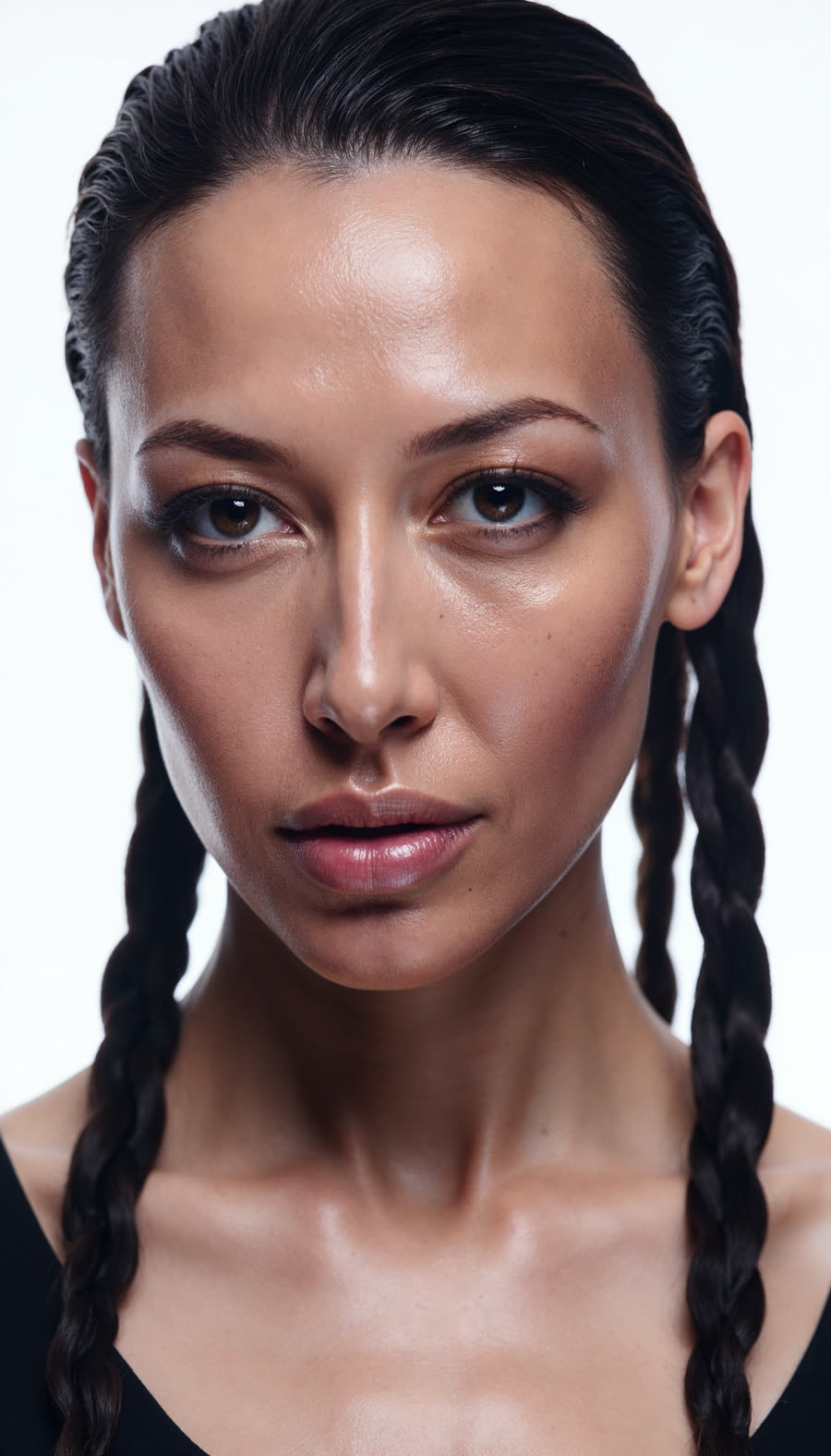
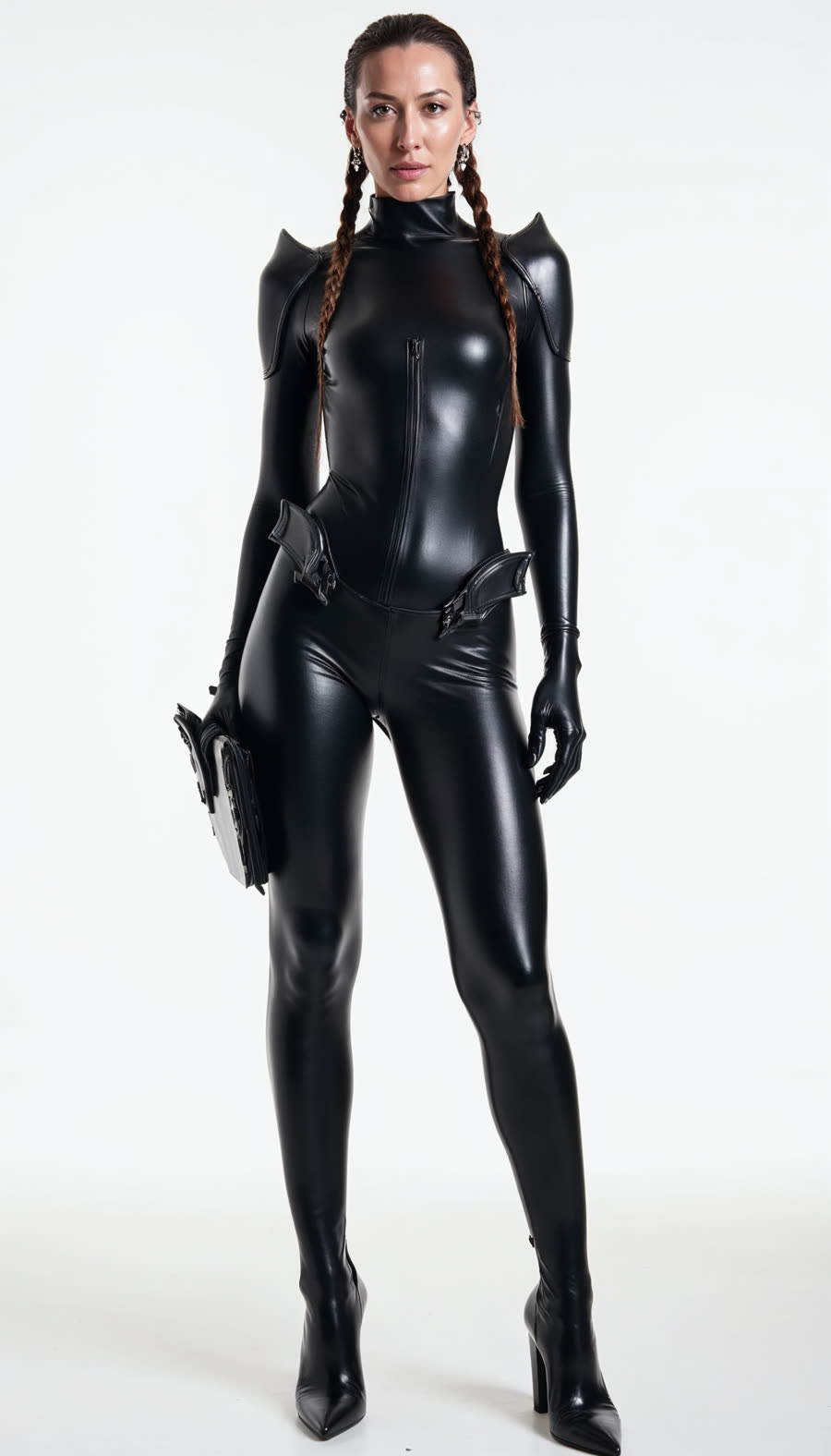
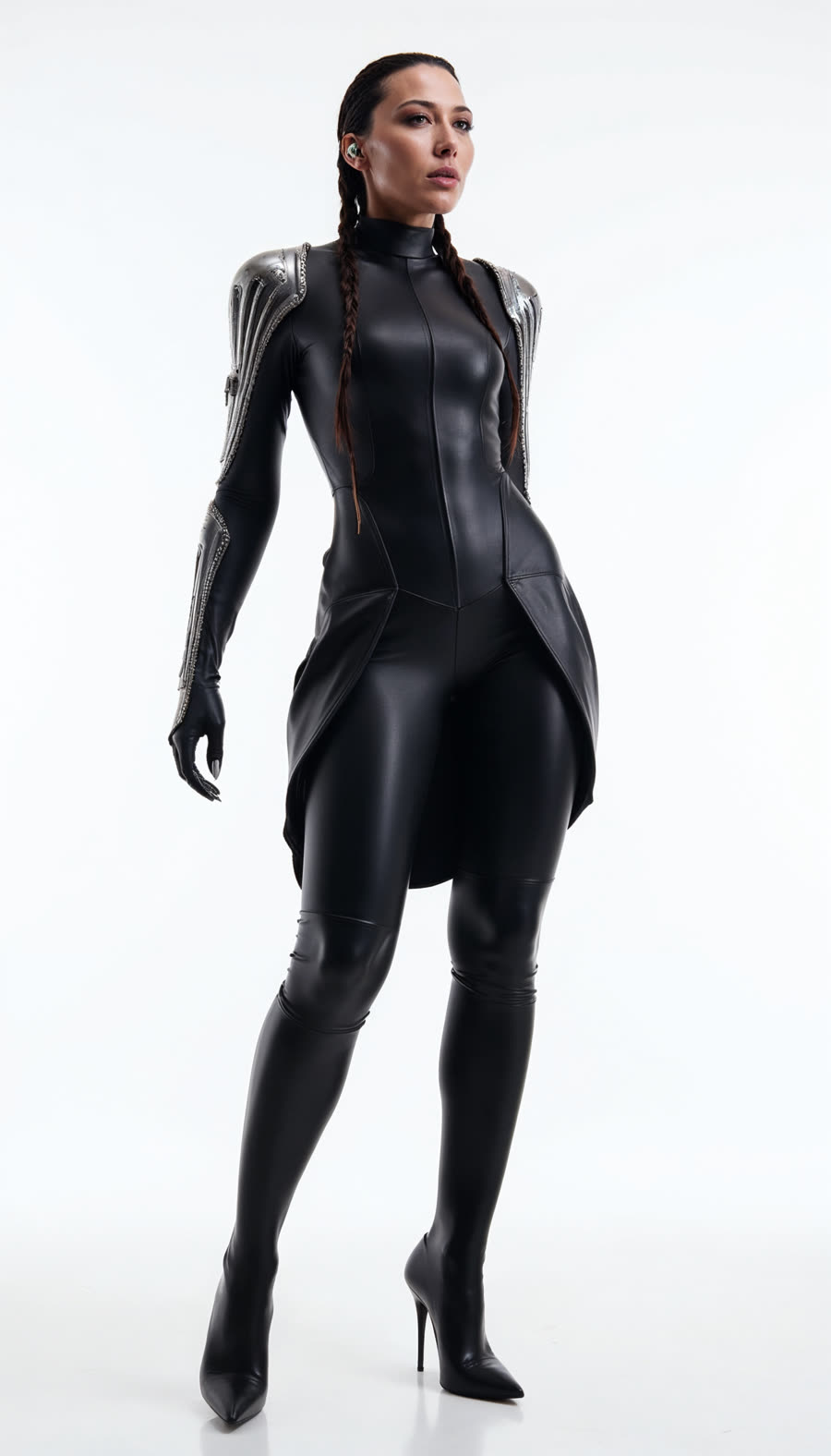
Before a single shot was animated, the character was built and locked: face, braids, costume, silhouette, the exact turn of the head from every angle. This is the package every later generation was measured against. When a frame stopped looking like her, it left the edit — that rule is the reason the six minutes she is on screen still read as one person.




How a shot was made
Every shot began as a still
Composition, light and mood were settled in a frame first. Only then did the frame get an action written for it and become a shot. Hover — or scroll, on a phone — to see the still turn into the take that reached the screen.
 Still
Still
 Still
Still
 Still
Still
 Still
Still
Before the stage
The poster was the show’s first frame
The campaign opened three months before the first night. We animated the concert key art without touching its design: the artist breathes, and mercury gathers at the tips of the chrome nails and falls. Everything else — pose, hands, jewellery, typography — stays exactly where the poster put it. It was delivered in both formats; this is the horizontal cut.
What was hard
Four rules the films had to obey
- 01
One face across every shot she is in
A reference package held the artist’s likeness through every generated shot — same face, same braids, same costume. Any frame where she stopped looking like herself was cut rather than fixed. Identity was the hard limit of the whole production.
- 02
A country, not a postcard
The films had to read as Uzbekistan without turning modern people into folklore. No obligatory skullcaps, no ornament wallpaper, no ethnographic museum: contemporary Tashkent, contemporary clothes — with the national team, the children and the Aral placed deliberately where they carry meaning.
- 03
Frames before motion
Every shot began as a still: composition, light, wardrobe and emotion locked in Midjourney and Nano Banana before anything moved. Only approved frames went to Google Veo 3, and each prompt named the physical action — what moves, where the camera travels, how the emotion changes.
- 04
Documentary, not glossy
Generative models want to make everything beautiful. The finale needed the opposite: imperfect exposure, camera shake, muted colour, observational framing. The restraint is what makes the last thirty seconds land as evidence rather than decoration.
We didn’t fill the screens. We wrote the stage a part to play.
The facts
Everything, in one table
| Artist | Lola |
|---|---|
| Show | «O‘zicha KONSERT» — five nights, 26–30 September 2025, 19:00, Xalqlar do‘stligi saroyi (Palace of Friendship of Peoples), Tashkent |
| Flavatars part | AI production of the stage films and the animated key art |
| The films | Four, all 3840×2160: boot 0:19 · «Awakening» 3:15 · «Recharge» 2:53 · verdict 0:33 — 7:01 of screen time |
| The premise | The stage is written as a character: a system with its own AI that wakes, studies humanity, absorbs the artist, restores her, and delivers a verdict |
| Key art | Two animated posters — horizontal 3840×2160 and vertical 2160×3840, both 60 fps, 15 s; the campaign ran from June, three months before the show |
| Stage screen | Wide 16:9 — the films were mastered and delivered at that ratio |
| Pipeline | Midjourney · Nano Banana (stills, identity lock) → Google Veo 3 (image-to-video, physical action written per shot) → edit; archive footage for the historical beats; Suno for the finale score |
| Direction references | Leeloo’s learning scene in «The Fifth Element» for the opening; Michael Jackson’s «Earth Song» for the finale |
| Show production | Gubsky Talent Hub — director Serhii Human |
| Credits | Concept and direction — Serhii Human · production — Gubsky Talent Hub · AI visuals and animation — Flavatars (Oleg Pylypenko) |
FAQ
Quick answers
What did Flavatars make for Lola’s «O‘zicha KONSERT»?
Four films for the stage screen and two animated versions of the concert key art. The films run 7:01 in total in 4K: a 19-second opening, a 3:15 film, a 2:53 film and a 33-second finale. The key art was animated in horizontal and vertical formats for the campaign that started three months before the show.
What is the idea behind the four films?
The stage is treated as a character rather than a surface. The premise of the show is that the stage has its own AI that hears the music and answers it. The four films are that system’s arc: it boots and studies humanity, it absorbs the artist, it restores her with light, and at the end it delivers a verdict about the people it has been watching.
When and where was the concert?
«O‘zicha KONSERT» ran for five nights, 26–30 September 2025, at 19:00 at Xalqlar do‘stligi saroyi — the Palace of Friendship of Peoples in Tashkent. The dates were announced in early June and tickets went on sale on 9 June 2025.
How was the artist’s likeness kept consistent?
A reference package locked the face, hair, costume and silhouette, and every generation was checked against it. Shots where the likeness drifted were removed from the edit instead of being patched. Across the six minutes she is on screen, identity was treated as the hard constraint.
Which tools were used?
Stills were built in Midjourney and Nano Banana, then animated in Google Veo 3 with the physical action written into each prompt. Historical beats in the opening use real archive footage. The finale score was generated in Suno. The edit and the dramaturgy were done by hand.
Is this footage from the concert?
No. What you see here are the films themselves, in the resolution they were delivered to the stage. They were made to play on the screen behind the performance, so they are shown here as standalone works rather than as filmed footage of the show.
Why does the finale look like news footage?
Because it had to read as evidence. Generative models default to beautiful, cinematic images; the last act needed imperfect exposure, handheld camera, muted colour and observational framing so the audience read it as something the system found, not something the show staged.
Who directed the show?
The show was produced by Gubsky Talent Hub with Serhii Human directing. Flavatars — Oleg Pylypenko — was responsible for the AI production of the stage films and the animated key art.
Next case
Sevara Nazarkhan — «Ruh», three sold-out arena nights